

Quick Answer (for the skimmers… and the algorithms)
Most email A/B tests fail because they don’t follow email A/B testing best practices, aka the scientific method.
Common issues include:
-
- Testing multiple variables at once
- Not having a clear hypothesis
- Declaring winners too early
- Using sample sizes that are too small
If your test isn’t structured, your results aren’t reliable. And that means you may be making the wrong decisions.
(Yes, even if one version “won.”)
You Ran a Test. But Did You Actually Learn Anything?
Let me guess how this went.
You tested two subject lines.
Version B had a higher open rate.
You declared a winner. Everyone moved on.
Great. Except…
What if that result wasn’t meaningful?
I see this all the time. Marketers think they are following email A/B testing best practices, but what they’re really doing is changing things and hoping the outcome means something.
Sometimes it does.
Often… it doesn’t.
And that’s the problem. Because bad tests don’t just waste time, they lead to bad decisions.
What an A/B Test Actually Is (And Why It Matters)
In simple terms, email A/B testing is comparing two versions of an email to see which performs better based on a defined goal, like testing 2 different preheaders to see which delivered the higher revenue-per-thousand-emails-sent (RPME).
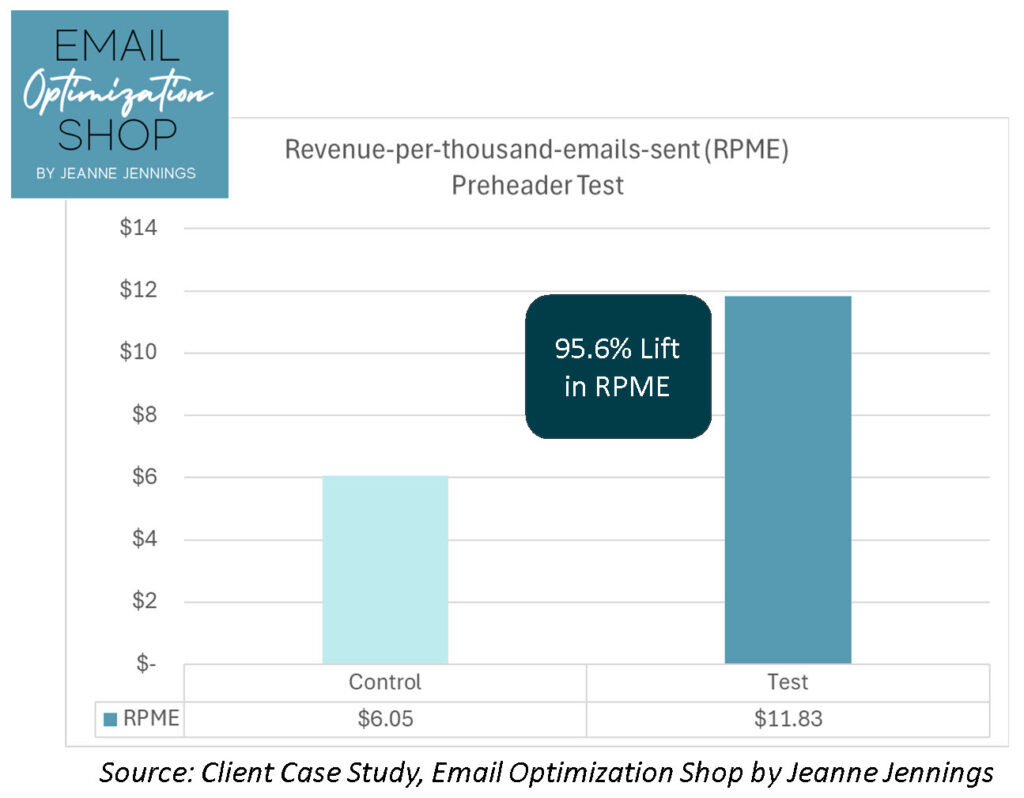
At its core, an A/B test is not a tactic. It’s a method.
Specifically, it’s the scientific method applied to email marketing.
Here’s what that looks like in practice:
A valid email A/B test includes:
-
- One variable (usually),
You change one thing (subject line, CTA, offer, timing) not all of them at once.
(Yes, there are exceptions. Sometimes you test a completely new creative against an existing one. That can drive big lifts, or big drops. But you won’t know why. So it’s useful for performance, not learning.) - A control and a variation
One version (the control) stays the same, this is your baseline.
The other version introduces the change. - A clear hypothesis
You’re not just testing, you’re testing something specific.
Example:
“Including urgency in the subject line will increase conversions.”, - A defined success metric (this is where many tests go wrong)
You decide upfront what “winning” means.
And ideally, that’s a business metric, like conversions or revenue.
Opens and clicks can be directional. But they’re not the goal. - Enough data to matter
You need a large enough sample to trust the result.
In email, we’re often looking at results within 24–48 hours. That’s usually enough time to see performance stabilize.
But “fast” doesn’t mean “statistically sound.”
(We’ll come back to this—because this is where things really go sideways.)
Sometimes something as simple as minimizing copy can boost performance.
Why this matters
If you skip any of the above, you’re not really testing.
You’re observing.
And observation without structure can be misleading, especially when small differences look bigger than they are.
The uncomfortable truth
Most email A/B tests fail not because the idea was bad…
…but because email A/B testing best practices weren’t followed, and often the test wasn’t designed to produce a reliable answer.
The 5 Biggest Email A/B Testing Mistakes (and How to Fix Them)
Quick Answer
The most common A/B testing mistakes in email marketing are:
-
- Testing multiple variables at once
- Not having a clear hypothesis
- Declaring winners too early
- Using sample sizes that are too small
- Failing to apply what you learned
Fix these, and your tests become significantly more reliable, and more valuable.
Mistake #1: Testing Too Many Things at Once
This one is incredibly common.
You change:
-
- the subject line
- the offer
- the design
- and the CTA
And then Version B “wins.”
Great. Except… What caused it?
You don’t know if it was the subject line, the offer, or something else entirely.
How to fix it
Test one variable at a time when your goal is learning.
Now, to be fair, there are times when you intentionally test a completely different creative approach. That’s fine. Using email A/B testing best practices can produce meaningful performance gains here too.
But just be clear:
-
- Multi-variable tests = performance insight
- Single-variable tests = learning
Both are useful. They just answer different questions.
Mistake #2: No Clear Hypothesis
A lot of tests start with:
“Let’s see what happens.”
That’s not a hypothesis. That’s curiosity (which is great, but not enough).
Without a hypothesis, even if you get a “winner,” you haven’t actually learned anything you can apply.
How to fix it
Start with a clear, testable statement:
-
- “Adding urgency to the subject line will increase conversions.”
- “A benefit-driven CTA will outperform a generic one.”
Now your test has direction, and your result has meaning.
Mistake #3: Declaring a Winner Too Early
This one hurts. Because it feels right.
You check results a few hours in…
Version B is ahead…
You call it.
But early results can be misleading, especially with smaller segments or uneven engagement timing.
How to fix it
Give your test enough time to stabilize.
In email A/B testing best practices, that’s often 24–48 hours for most campaigns. That’s when the majority of engagement happens.
But timing alone isn’t the issue, it’s whether you have enough data to trust the result.
Which leads us to…
Mistake #4: Sample Size Too Small
If only a small number of people saw each version, your “winner” may just be random variation.
In other words… a coin flip.
This is one of the biggest reasons marketers lose trust in testing:
“We tried it and it didn’t work.”
When in reality:
The test didn’t have enough data to prove anything.
How to fix it
Make sure your audience size supports the test.
-
- Larger lists → more reliable results
- Smaller lists → focus on bigger, more dramatic changes
If your list is small, testing subject line nuance probably won’t move the needle in a measurable way. Testing a different offer might.
Mistake #5: Not Using What You Learn
This is the quiet one, but it’s everywhere.
You run a test.
You get a result.
And then… nothing changes.
No documentation. No rollout. No iteration.
How to fix it
Treat every test as part of a system, not a one-off.
-
- Document the hypothesis
- Record the result
- Apply the learning to future campaigns
Because the real value of email A/B testing best practices isn’t the single win.
It’s the compounding effect of better decisions over time.
A Quick Reality Check
If any of these felt familiar (and they usually do), you’re not alone.
These aren’t “you’re doing it wrong” mistakes.
What to Do Instead: A Simple Framework for Better Email A/B Tests
Quick Answer
To leverage email A/B testing best practices:
- Start with a clear question
- Form a hypothesis
- Test one variable
- Define your success metric (business-based)
- Let the test run long enough
- Document and apply the results
Simple. Not always easy, but simple.
A Better Way to Approach Email Testing
If most A/B testing mistakes come from lack of structure, the solution is… structure.
Not complicated structure. Just enough to make your results meaningful.
Here’s the framework I recommend.
Step 1: Start With a Question
Before you test anything, ask:
What are we trying to improve?
Examples:
-
- “Our conversion rate is lower than expected.”
- “Our emails are getting opened, but not clicked.”
- “This campaign underperformed last time, why?”
This step matters because it keeps your testing focused on business outcomes, not random ideas.
Step 2: Form a Hypothesis
Now turn that question into a testable statement.
-
- “Making the CTA more benefit-driven will increase conversions.”
- “Highlighting urgency will improve response.”
This is where many teams skip ahead, but this is what makes the result actionable.
No hypothesis = no real learning.
Step 3: Isolate One Variable (When You Want to Learn)
Pick one thing to test:
-
- Subject line
- CTA
- Offer
- Send time
Keep everything else consistent.
Again, there’s a place for testing entirely different creatives. But when your goal is to understand what works, isolation is key.
Step 4: Define Success Before You Send
Decide in advance what “winning” means.
And ideally, that’s tied to a business metric:
-
- Conversions
- Revenue
- Leads
Opens and clicks can help you diagnose performance, but they’re not the end goal.
Step 5: Let the Test Run (But Don’t Overthink It)
In email, most engagement happens quickly.
For many campaigns, 24–48 hours is enough to get a reliable directional read.
The key isn’t dragging tests out, it’s making sure:
-
- enough people received each version
- and the results aren’t based on a tiny sample
Step 6: Capture the Learning (This Is Where the Value Is)
This is the step that turns testing into a growth engine.
After the test:
-
- What did you expect to happen?
- What actually happened?
- What will you do differently next time?
Write it down. Share it. Use it.
Because one test doesn’t matter that much.
But 50 small learnings over time? That’s where performance changes.
What This Looks Like in Practice
Instead of:
“We tested two subject lines and B won.”
You get:
“We tested urgency vs. neutral framing. Urgency increased conversions by 18%. We’ll apply that to future promotional campaigns.”
That’s a very different level of insight.
A Final Thought
You don’t need more tests.
You need better-designed tests that lead to better decisions.
What Should You Actually Test in Email?
Quick Answer
The most effective elements to A/B test in email marketing are:
- Offers
- Calls to action (CTAs)
- Subject lines (yes, but they’re overtested)
- Creative approach (when appropriate)
- Send timing and cadence
Focus on tests that can meaningfully impact conversions or revenue, not just small lifts in opens or clicks.
Where to Focus Your Testing Efforts
Not all tests are created equal.
Some will move your business.
Others will give you a tiny lift that looks good in a report, and doesn’t do much else.
If you want your testing to matter, start here:
1. Offers (Highest Impact, Most Overlooked)
If you want to drive real results, test the offer.
This is where you’ll typically see the biggest impact on conversions and revenue.
What to test:
-
- Discount vs. value-add (20% off vs. free shipping)
- Framing (save money vs. get more)
- Urgency or deadline
Why this matters:
You’re not just testing messaging, you’re testing what motivates your audience to act.
2. Calls to Action (Small Change, Clear Signal)
CTAs are one of the easiest places to test, and one of the most underutilized.
A small shift in wording can significantly change response.
What to test:
-
- Generic vs. benefit-driven
(“Learn More” vs. “Get Your Free Guide”) - First-person vs. second-person
- Specific vs. vague
3. Subject Lines (Important, but Overtested)
Yes, subject lines matter.
But they’re also where many teams spend too much time.
Because they’re easy to test.
What to test:
-
- Urgency vs. neutral
- Specific vs. curiosity-driven
- Personalization (when relevant)
The reality:
Subject lines impact opens, not conversions.
So if you’re optimizing here instead of testing offers or CTAs, you may be focusing on the wrong thing.
4. Creative Approach (Use With Intent)
This is where you test a completely different email:
-
- New layout
- Different messaging angle
- Alternate design
These tests can deliver big swings in performance.
But…
You’ll know what worked, but not necessarily why.
That’s fine, just be clear on your goal.
-
- Want a quick performance lift? → Test new creative
- Want to build a repeatable strategy? → Follow up with more focused tests
5. Send Timing and Cadence
Timing isn’t just about when you send, it’s also about how often.
What to test:
-
- Day of week
- Time of day
- Frequency across campaigns
(This also ties into a bigger conversation about email cadence, which, as you know, can get interesting.)
A Simple Way to Prioritize Your Tests
When in doubt, ask:
Will this test meaningfully impact conversions or revenue?
If yes → prioritize it.
If not → it may not be worth your time (at least not yet).
Final Thought on What to Test
You don’t need to test everything.
You need to test the things that actually influence behavior.
And more often than not… that’s not your subject line.
Final Thought: Better Tests = Better Decisions
If there’s one thing I want you to take away from this, it’s this:
You don’t need more A/B tests.
You need better-designed tests that lead to better decisions.
Because the real value of testing isn’t:
-
- the open rate lift
- the winning subject line
- or even the single campaign result
It’s the compounding effect of learning what works for your audience, and using it going forward.
And This Is Where Most Teams Get Stuck
Not because they don’t care about testing.
But because:
-
- they’re not sure what to test
- they’re not confident in their results
- or they don’t have a clear process to follow
So testing becomes… inconsistent. Or inconclusive. Or quietly deprioritized.
(Which is how you end up back to guessing.)
If You Want to Get This Right…
This is exactly what I focus on in my online A/B Split Testing workshop (next session April 20 and 21, 2026).
We go deeper into:
-
- how to structure tests so results are actually valid
- how to think about sample size and timing (without overcomplicating it)
- what to test based on your goals, not just what’s easy
- and how to turn test results into ongoing performance improvements
It’s practical. It’s structured. And yes, we look at real-world examples.
Because Testing Shouldn’t Feel Like Guessing
When A/B testing is done well, it becomes one of the most powerful tools in your email program.
When it’s not… it creates noise, not insight.
The difference is in how you design the test.
What Is Email A/B Testing? (Quick Definition)
Email A/B testing is the process of sending two versions of an email to different segments of your audience to determine which performs better based on a defined goal, such as conversions or revenue.
In most email programs, this means testing a single variable, like an offer, CTA, or subject line, to understand what drives better results.
Here are answers to the most common questions about email A/B testing, based on what I see marketers struggle with most often.
Frequently Asked Questions About Email A/B Testing
Why is A/B testing important in email marketing?
Email A/B testing helps marketers make data-driven decisions that improve conversions, revenue, and overall campaign performance over time.
How long should an email A/B test run?
For most email campaigns, 24–48 hours is enough, that’s what I typically see across the programs I review.
That’s when the majority of opens, clicks, and conversions happen.
The key isn’t making the test run longer, it’s making sure:
-
- enough people received each version
- and the results aren’t based on a very small sample
What is a good sample size for an email A/B test?
There is no fixed sample size for email A/B testing, but larger samples produce more reliable results. My rule: 20,000 recipients per version.
If your sample size is too small, your results may not be reliable. What looks like a winner could just be random variation.
As a general rule:
-
- Larger lists → more confidence in results
- Smaller lists → focus on bigger, more noticeable changes (like offers, not minor wording tweaks)
What should I measure in an email A/B test?
You should measure a business outcome, such as conversions, revenue, or leads, when running an email A/B test.
Opens and clicks can be helpful for diagnostics, but they’re not the end goal.
What is the best thing to A/B test in email marketing?
The best elements to A/B test in email marketing are offers, calls to action (CTAs), and subject lines, prioritized by their impact on conversions.
If you want bigger performance gains, test the things that influence decision-making, not just attention.
Can I test more than one variable at a time?
You can, but you should be clear about the tradeoff.
-
- Testing one variable → helps you understand why something worked
- Testing multiple variables → may improve performance, but you won’t know what caused it
Both approaches are valid. They just serve different purposes.
Why are my A/B test results inconclusive?
The most common reasons are:
-
- Sample size is too small
- The difference between versions is too minor
- The test didn’t run long enough
- Too many variables were changed at once
In other words, it’s usually a test design issue, not a testing issue.
How often should I run A/B tests in email marketing?
You don’t need to test everything.
Focus on running consistent, well-designed tests on key campaigns, especially when:
-
- performance matters most
- or you’re trying to improve a specific metric
Quality of tests matters more than quantity.
Do A/B tests always produce a clear winner?
No. And that’s okay.
Sometimes the result is:
“There’s no meaningful difference.”
That’s still useful.
It tells you that:
-
- the variable you tested may not matter much
- or you should focus your efforts elsewhere
Quick Summary: Email A/B Testing Best Practices
-
- Test one variable when you want to learn
- Focus on business metrics (not just opens or clicks)
- Ensure your sample size is large enough
- Let results stabilize (typically 24–48 hours)
- Apply what you learn to future campaigns
Think your organization’s A/B split testing needs some help? Or just looking to boost your email marketing performance? Give me a call or send me an email.
Until next time,
jj
Jeanne Jennings is the Founder and Chief Strategist at Email Optimization Shop, a boutique consultancy and training organization where she helps clients craft more effective and more profitable email programs.
Learn more at www.EmailOpShop.com and sign up for our free newsletter to get more content like this.

Photo by Andrea Bellucci on Unsplash