
Artificial intelligence (AI) is everywhere right now, and marketers are being told it will either revolutionize their jobs or replace them entirely.
The reality of AI for marketers is much more nuanced.
At a conference a while back, a speaker described AI as “the smartest person in the room” because it has ingested the entire internet.
I disagree.
AI isn’t the smartest person in the room. AI is a very smart intern. And that’s not an insult.
A smart intern can be incredibly helpful. A smart intern can help you move faster, generate ideas, tackle projects you’ve been putting off, and increase your productivity dramatically.
A smart intern can also be confidently wrong. A smart intern needs direction, context, and supervision.
And if you hand a smart intern an important project with little guidance, there’s a good chance you’ll spend more time fixing the work than you would have spent doing it yourself.
That’s how I think about AI. And how I teach others to use AI.
It’s one of the most powerful tools I’ve seen in my more than 20 years in email marketing. But it’s still a tool. And the marketers who get the most value from AI aren’t the ones who blindly trust it. They’re the ones who know how to direct it.
Will AI Replace Marketers?
No.
AI will automate some marketing tasks and dramatically improve productivity, but marketers are still needed for strategy, customer understanding, judgment, prioritization, testing, and accountability.
In fact, I believe the marketers who learn to work effectively with AI will become more valuable, not less.
The future doesn’t belong to marketers who ignore AI. But it doesn’t belong to marketers who blindly trust AI, either.
It belongs to marketers who know how to combine technology with human expertise.
What AI Does Really Well For Marketers
Let’s start with the good news.
AI is genuinely useful. I use it regularly, and it has dramatically increased my productivity.
AI is particularly good at:
- Brainstorming ideas
- Creating first drafts from notes
- Summarizing information
- Organizing research
- Analyzing large amounts of content
- Identifying patterns
Tasks that used to take hours can sometimes be completed in minutes.
That’s not hype. That’s reality.
AI Helps Me Synthesize, Not Strategize
One example from my own work is client audits.
When I’m conducting an audit, I take a lot of notes. There are stakeholder interviews, performance reports, campaign reviews, creative evaluations, and competitive observations. By the time I’m finished, I usually know where the story is going.
The problem is that the story is still in my head.
I have pages of notes, observations, and ideas, but they aren’t yet organized into a coherent narrative.
This is where AI has become incredibly valuable for me.
I’ll upload my notes and do what can only be described as a stream-of-consciousness download of everything I’m thinking. Then I’ll ask my Marketing Strategist custom GPT to help organize the information, identify themes, and connect supporting evidence to the conclusions I’m reaching.
Could I do that myself?
Absolutely.
In fact, for most of my career I did.
But AI helps me get there faster. It helps me turn a collection of observations into a structured analysis more efficiently, while still relying on my experience and judgment to determine what matters and what recommendations to make.
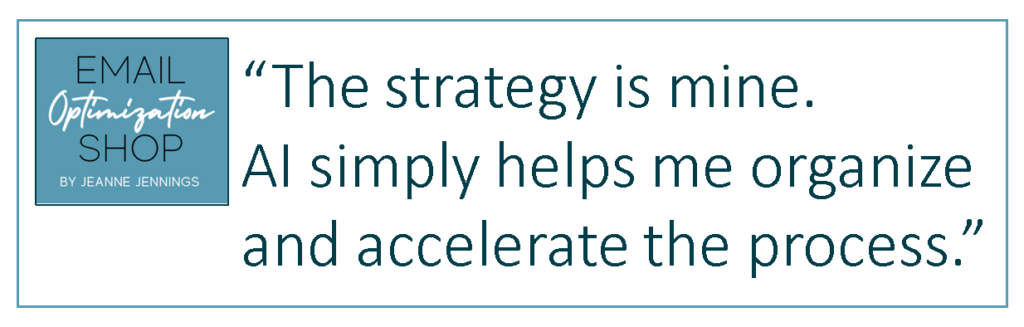
The strategy is mine. AI simply helps me organize and accelerate the process.
For marketers who are willing to learn how to use these tools effectively, AI can eliminate a tremendous amount of busy work and allow more time for higher-value activities.
And that’s where things get interesting. Because productivity is not strategy.
What Is AI Good At in Marketers?
AI excels at tasks that involve processing information, generating ideas, and accelerating execution.
In marketing, AI can be especially effective for:
- Research and summarization
- Content ideation
- Draft creation from notes
- Data analysis
- Workflow automation
However, AI is far less effective at making strategic decisions, understanding organizational context, or determining what matters most to a particular audience.
That’s where marketers come in.
What AI Doesn’t Do Well for Marketers
AI can write a subject line. But it can’t decide whether email is the right channel.
AI can create a welcome email. But it can’t determine whether your onboarding strategy aligns with customer expectations.
AI can generate a promotional message. But it can’t tell you whether the offer is compelling.
AI can write copy. But it can’t tell you whether you’re talking to the right audience.
Those decisions require context. They require judgment. They require understanding customers, business goals, competitive pressures, organizational realities, and the countless nuances that don’t exist in a prompt.
AI has access to an extraordinary amount of information. But it does not have experience.
And experience still matters.
AI can Analyze, But It Can’t Prioritize
One area where I’ve found AI less helpful is determining the winner of an email test.
I often use my Data Analyst custom GPT to help calculate metrics for client A/B tests, audience segments, and different types of email campaigns. It’s very good at the math. It can quickly calculate lifts, variances, conversion rates, revenue metrics, and other performance indicators.
But when I ask it which version won the test, things get interesting.
AI tends to report back that Version A had the highest open rate, Version B had the highest click-through rate, and Version C generated the most revenue. In other words, it tells me who “won” each individual metric.
What it doesn’t do particularly well is make the strategic judgment call.
Which metric mattered most? Were the differences statistically significant? Did one version outperform on the KPI that actually matters to the business? Do the supporting metrics reinforce the conclusion or raise additional questions?
Those are the decisions experienced marketers make every day.
AI can calculate the numbers. It can summarize the results. But it often struggles to weigh competing factors and determine what matters most.
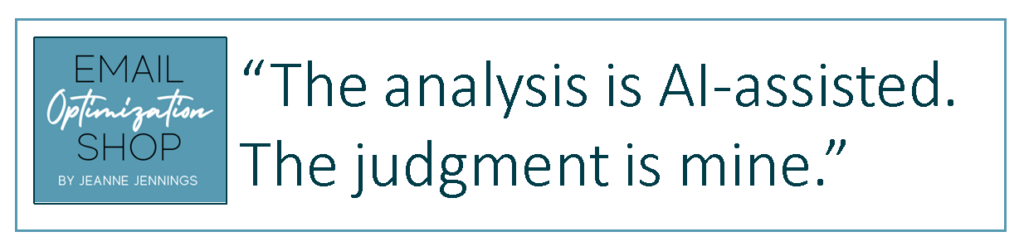
That’s not a math problem. That’s a judgment problem.
The Real Risk for Marketers Isn’t AI
When people talk about AI replacing marketers, I think they’re focusing on the wrong issue.
The real risk isn’t AI.
The real risk is outsourcing your thinking.
I’ve also seen marketers overestimate what AI can do on its own. AI works best when it’s given a strong strategic foundation to build upon.
When I’m using AI, I rarely start with a blank page. I typically provide information about the audience, business goals, messaging priorities, customer objections, or testing objectives and ask AI to help me expand, refine, or challenge my thinking.
That’s very different from asking AI to figure everything out for me.
For example:
- I provide information about the audience and ask AI to help me identify additional motivations or concerns.
- I provide messaging ideas and ask AI to suggest alternative approaches.
- I share known customer objections and ask AI to help me develop responses.
- I outline a testing strategy and ask AI to identify gaps or additional opportunities.
In each case, the strategic direction comes first. AI helps strengthen the work, but it doesn’t replace the thinking behind it.
That’s an important distinction.
AI’s output is heavily influenced by the quality of the information, context, and direction it receives.
Why Marketing Fundamentals Matter More Than Ever in the Age of AI
One of the unexpected consequences of AI is that marketing fundamentals are becoming more valuable, not less.
The marketers who get the best results from AI are usually the marketers who already understand:
- Their target audience
- Customer motivations
- Objections and barriers to conversion
- Messaging strategy
- Positioning
- Testing methodology
- Customer journeys
In other words, they understand marketing. Because AI needs direction.
The quality of the output depends heavily on the quality of the inputs.
If you can clearly define your audience, explain their challenges, identify the benefits that matter most, and articulate your goals, AI becomes much more useful.
If you can’t, AI often produces generic content that sounds fine but accomplishes very little.
I’ve spent years teaching marketers about target audiences, personas, customer journeys, messaging, and testing. Those concepts aren’t becoming obsolete. They’re becoming more important.
AI doesn’t replace marketing fundamentals. It exposes whether you have them.
The Marketers Who Will Thrive with AI
Every major technology shift creates anxiety.
I’ve lived through quite a few.
- The rise of the internet.
- The rise of email marketing.
- Marketing automation.
- Social media.
- Mobile.
- And now AI.
Each time, there were predictions that marketers would become less important. What actually happened was that the marketers who adapted became more valuable.
I think the same thing will happen with AI.
The marketers who thrive won’t necessarily be the ones with the biggest prompt libraries. They won’t be the ones trying every new tool that launches.
They’ll be the marketers who:
- Understand customers deeply
- Think strategically
- Ask good questions
- Evaluate ideas critically
- Know how to test and learn
- Can separate useful insights from noise
- Are willing to keep learning
In other words, they’ll be marketers first and AI users second.
Five Ways Marketers Can Work Better with AI
If you’re experimenting with AI (and you probably should be), here are a few principles that have served me well.
1. Start with strategy, not prompts.
Know what you’re trying to accomplish before you ask AI for help.
2. Give AI context.
The more information you provide about your audience, goals, and constraints, the better the output.
3. Verify everything.
AI can be incredibly helpful. It can also be incredibly confident when it’s wrong.
4. Edit aggressively.
Treat AI-generated content as a draft, not a final product.
5. Measure outcomes, not activity.
The goal isn’t to use AI. The goal is to improve results.
Key Takeaways
- AI is a powerful productivity tool, not a replacement for strategic thinking.
- The most successful marketers use AI to accelerate execution, not replace judgment.
- Marketing fundamentals matter more, not less, in the age of AI.
- AI performs best when given strong strategic direction.
- The marketers who thrive will combine AI skills with customer understanding and business expertise.
The Bottom Line
The best interns don’t replace experienced marketers. They help experienced marketers accomplish more.
AI is no different.
It’s an incredibly powerful addition to your team. It can help you move faster, think bigger, and tackle projects that once seemed impossible.
But it still needs direction. It still needs oversight. And it still needs someone accountable for the outcome.
AI may be your newest team member. But you’re still the boss.
Frequently Asked Questions
Will AI replace email marketers?
AI will automate some email marketing tasks, but marketers are still needed for strategy, audience understanding, testing, decision-making, and accountability.
What marketing tasks can AI perform?
AI can assist with brainstorming, research, summarization, content creation, analysis, personalization support, and workflow automation.
What can’t AI do well?
AI struggles with strategic judgment, organizational context, customer empathy, business prioritization, and understanding the unique nuances of a specific organization or audience.
How should marketers use AI?
Marketers should use AI to accelerate research, ideation, drafting, and analysis while maintaining responsibility for strategy, oversight, and results.
Until next time,
jj
Jeanne Jennings is the Founder and Chief Strategist at Email Optimization Shop, a boutique consultancy and training organization where she helps clients craft more effective and more profitable email programs.
Learn more at www.EmailOpShop.com and sign up for our free newsletter to get more content like this.
Author’s Note
AI tools were used to assist with brainstorming, drafting, and editing portions of this article. The perspectives, recommendations, and conclusions shared here are based on more than 20 years of hands-on email marketing strategy, testing, consulting, and training experience.

Photo by Carrie Allen www.carrieallen.com on Unsplash