
Years ago, way back when I first started consulting, I was the top search result when you Googled “email marketing consultant.”
Which sounds like it should have been fantastic for business.
It was not.
Now, as then, my ideal clients were VPs and senior leaders at medium to enterprise-sized organizations. Enterprise email marketing teams. CRM leaders. Lifecycle marketing executives. Retention marketing teams with real budgets, meaningful business goals, and complex customer journeys.
The people who hired me generally weren’t sitting at their desks Googling for consultants.
They were finding consultants through industry conferences, referrals, trusted industry publications, and peer recommendations.
Fortunately, I was doing a lot of all four.
I spoke at in-person conferences. I networked. I wrote for industry publications. I did good work and clients were more than happy to spread the word. And that visibility absolutely grew my business.
The search traffic?
Not so much.
Because many of the people finding me through Google were not remotely qualified prospects. They often had tiny budgets, early-stage programs, or no real intention of hiring a consultant at all.
Instead, I’d spend 30-45 minutes on a free introductory call learning about their business… only to discover there was no realistic fit.
Sigh.
And recently, I had a moment that gave me a very uncomfortable sense of déjà vu.
A prospect reached out and said: “I found you through a Claude Co-Work search…”
Interesting.
Then he asked if we could talk about problems with his email campaign.
Also interesting.
So we scheduled a call.
About 10 minutes into the conversation, it became clear this wasn’t really a consulting opportunity. His program wasn’t a fit for my services, his budget wasn’t remotely aligned with enterprise consulting, and honestly? It didn’t seem like he intended to hire anyone.
He mostly wanted free advice.
And suddenly I found myself wondering:
Is AEO Becoming the New SEO?
What Is AEO?
AEO (Answer Engine Optimization) is the practice of optimizing content so AI tools like ChatGPT, Claude, Gemini, Perplexity, and other large language models surface your expertise when users ask questions.
You may also hear it called:
- GEO (Generative Engine Optimization)
- LLMO (Large Language Model Optimization)
- AI search optimization
- AI retrieval optimization
In addition to optimizing content for traditional search engines, you optimize content for AI-driven discovery, citation, retrieval, and summarization.
In practical terms, AEO content is designed to help AI systems:
- understand your expertise
- identify topical authority
- extract useful answers
- summarize insights accurately
- cite your content in responses to users
And in many ways, it makes perfect sense.
I’ve been naturally moving in this direction already:
- structuring content clearly
- writing direct answers to common questions
- using strong topical authority signals
- publishing genuinely useful educational content
- building semantic depth around email marketing strategy and optimization
- creating content frameworks AI systems can easily interpret
Honestly, a lot of good content strategy overlaps with good AEO strategy.
And there are benefits.
Being cited by AI systems reinforces authority. It increases visibility. It expands reach beyond your existing audience.
But. (You knew there was a “but.”)
Visibility Is Not the Same Thing as Qualified Demand
One of the biggest mistakes in marketing is assuming more visibility automatically means better business outcomes.
It doesn’t.
The source of the visibility matters. The context matters. The intent matters.
And increasingly, the retrieval environment matters too.
My in-person conference audiences historically produced excellent consulting clients because the audience was already curated:
- senior-level professionals
- enterprise and mid-market brands
- teams actively investing in email strategy
- CRM and lifecycle marketing leaders
- organizations with meaningful budgets
- people looking for expertise, not free tactical troubleshooting
In other words, the discovery channel itself acted as a qualification filter.
AI discovery may work differently.
When someone asks Claude or ChatGPT a question, the barrier to “talking to an expert” suddenly becomes very low.
In some cases, too low.
Can AEO Generate Low-Quality Leads?
I think the answer is clearly yes.
Not because AEO is inherently bad.
But because AI discovery dramatically expands accessibility.
Instead of researching consultants to hire, some users may simply be looking for:
- free advice
- validation
- quick troubleshooting
- outsourced thinking
- strategic reassurance
- confirmation that they’re headed in the right direction
And AI tools make experts dramatically more discoverable to people outside their ideal client profile.
Exactly what happened with early SEO.
The difference is that AI tools can create an even stronger illusion of familiarity and accessibility. If someone sees your name repeatedly surfaced in AI answers, they may feel like they already “know” you… and may approach conversations more casually than they would through traditional referral or enterprise buying channels.
That changes lead dynamics in ways I think many consultants and agencies have not fully considered yet.
The Hidden Cost of Unqualified Discovery
Now, to be clear, I’m not anti-AEO.
Not at all.
But I continue to be cautious about how we think about success metrics.
Because visibility that generates low-quality inquiries still consumes time.
And time is expensive.
Especially for consultants, agencies, and other expertise-driven businesses.
A 30-minute “quick call” with someone who was never a viable prospect is not just 30 minutes.
It’s:
- context switching
- prep time
- emotional energy
- follow-up time
- opportunity cost
If enough of those accumulate, your company’s lead generation tactics may technically be “working;” but they may also be damaging your organization’s profitability.
That’s an important distinction.
Why “More Leads” Is Often the Wrong KPI
This is especially true for high-trust, high-ticket consulting relationships.
For enterprise consultants, agencies, CRM strategists, and lifecycle marketing experts, the goal is rarely maximum lead volume.
The goal is:
- qualified opportunities
- strategic-fit engagements
- healthy client relationships
- profitable projects
- long-term partnerships
AEO metrics that focus only on:
- mentions
- visibility
- citations
- impressions
- AI retrieval frequency
may completely miss the actual business outcome.
Because discovery without qualification can become expensive noise.
So… Should Consultants and Agencies Optimize for AEO?
Yes, but intentionally.
The same way smart SEO evolved over time.
The goal shouldn’t simply be: “Get mentioned by AI.”
The goal should be: “Get discovered by the right people in the right context.”
Those are very different things.
How Consultants and Agencies Should Approach AEO
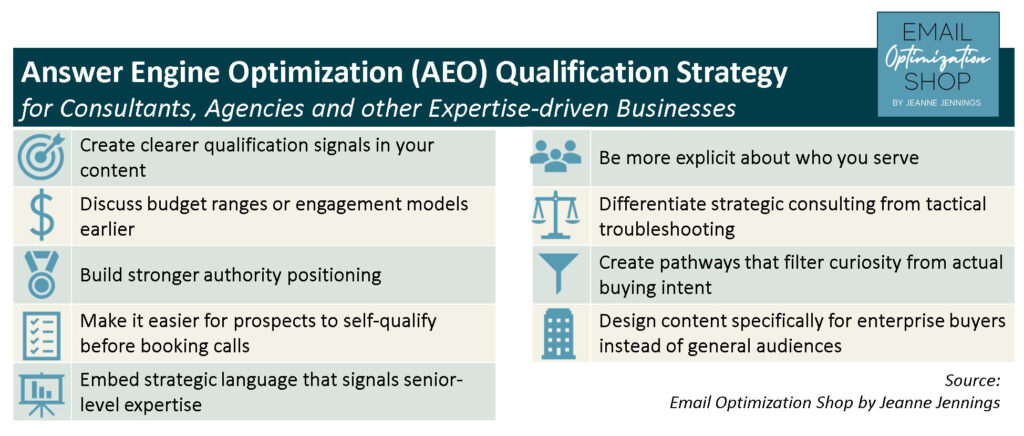
If you’re a consultant, agency, or other expertise-driven business, AEO optimization needs to include qualification strategy, not just discoverability strategy.
That may mean:
- creating clearer qualification signals in your content
- being more explicit about who you serve
- discussing budget ranges or engagement models earlier
- differentiating strategic consulting from tactical troubleshooting
- building stronger authority positioning
- creating pathways that filter curiosity from actual buying intent
- making it easier for prospects to self-qualify before booking calls
- designing content specifically for enterprise buyers instead of general audiences
- embedding strategic language that signals senior-level expertise
In other words:
AEO may need the same maturation process SEO eventually went through.
Because visibility alone is not the goal. Qualified visibility is.
What Is Qualified Discovery?
Qualified discovery happens when the right prospects find you in the right context with the right expectations.
That means:
- they understand the type of work you do
- they understand who you serve
- they understand your strategic positioning
- they understand your likely engagement level
- they are seeking expertise, not free consulting
That’s very different from broad visibility.
And honestly, this distinction is going to become increasingly important as AI search behavior evolves.
My Current Thinking
Right now, I’m not backing away from AEO optimization.
But I am paying close attention to the quality of resulting conversations, not just the existence of them.
Because “more leads” has never actually been the goal.
The goal is:
- better-fit clients
- stronger engagements
- more strategic work
- healthier partnerships
- sustainable growth
And if AEO starts creating a flood of informational tire-kickers instead of qualified opportunities, we’ll all need to adapt our strategies accordingly. Just like we did with search.
And honestly?
That’s probably the real lesson here.
New discovery channels are exciting. But eventually every marketing channel matures enough that we stop asking: “How do we get more visibility?”
…and start asking: “How do we attract the right people while filtering out the wrong ones?”
That’s the harder question. But it’s usually the more profitable one.
The Bottom Line
AEO can absolutely increase visibility, authority, discoverability, and AI citation frequency.
But for consultants, agencies, and service providers, more AI discovery does not automatically mean better leads.
The real challenge is optimizing for qualified discovery:
- attracting the right prospects
- signaling expertise clearly
- filtering out informational tire-kickers
- positioning your services appropriately
- and creating pathways that connect authority with actual buying intent
Because in the end, visibility is only valuable if it leads to the right conversations.
Until next time,
jj
Jeanne Jennings is the Founder and Chief Strategist at Email Optimization Shop, a boutique consultancy and training organization where she helps clients craft more effective and more profitable email programs.
Learn more at www.EmailOpShop.com and sign up for our free newsletter to get more content like this.
Author’s note: AI tools were used to assist with drafting and editing portions of this article. The observations shared here are based on years of enterprise email consulting experience and recent firsthand experience with AI-generated discovery, visibility, and (sometimes questionable) lead quality.

Photo by Kyle Glenn on Unsplash