
You know that warm, fuzzy marketing feeling when someone joins your list?
Yeah. My clients don’t feel it either.
Because getting the email address is just the beginning.
Too often, I see organizations treat it like the finish line. They celebrate the signup, fire off a generic welcome, and then drop that new subscriber into a random newsletter stream. That’s not nurturing. That’s neglect with good intentions.
When we do that, we’re leaving people hanging, prospects who literally raised their hands and said, “Tell me more.”
That’s where a real lead nurture strategy comes in.
One with structure. One that speaks to prospect needs as they evolve. One that actually moves people down the funnel instead of letting them drift away.
I spend a lot of time helping clients build and optimize these journeys. And this Lead Nurture Funnel framework is my go-to model for a thoughtful, high-performing nurture program.
The Funnel at a Glance

We’re keeping it simple here with just three stages:
- Awareness
- Consideration
- Decision
Each stage reflects a shift in how your prospect is thinking, and what they need from you. The key is to meet them where they are, not where you want them to be.
What You Should Be Providing At Each Stage — and Why — Based on the Lead Nurture Funnel
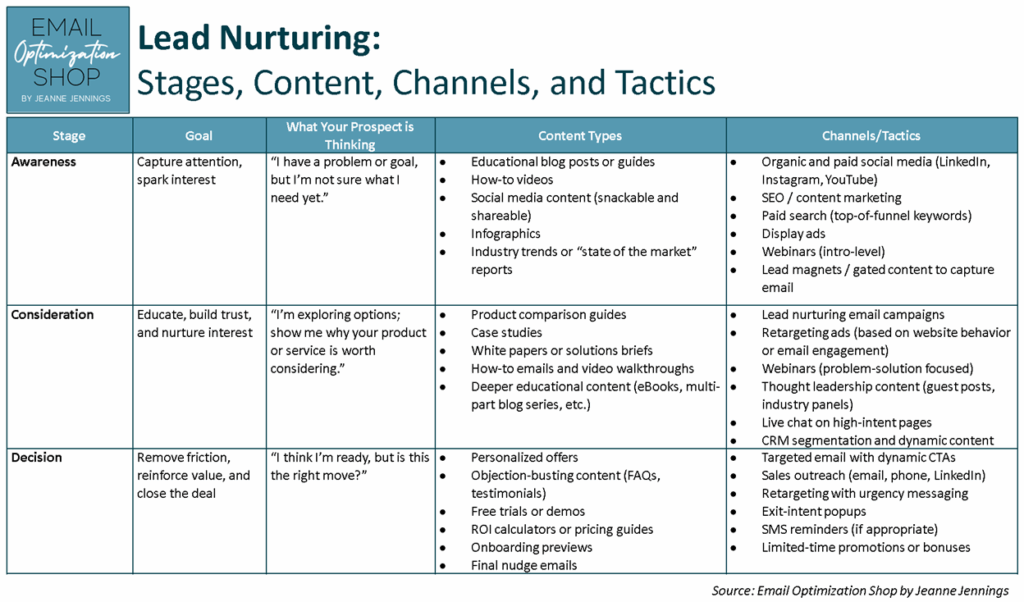
This is where the strategy becomes tangible.
Let’s walk through the stages of the lead nurture funnel.
Awareness
- Goal: Capture attention and spark interest.
- What I Often See: Clients open too strong with product-first, brand-heavy messaging, and not enough empathy.
- What Works Better: Educational, useful content that earns trust. Think short guides, infographics, or quick “how-to” videos.
- Tone: Friendly expert. “We get what you’re up against, and here’s something that’ll help.”
Consideration
- Goal: Educate, build trust, and nurture genuine interest.
- What I Often See: A flood of feature lists and salesy comparisons that feel one-sided.
- What Works Better: Stories that connect — case studies, product comparison guides, webinars that show the problem and the solution.
- Tone: Still helpful, but now you’re guiding the conversation. “Here’s how we’ve solved this before — and how we can help you.”
Decision
- Goal: Remove friction, reinforce value, and close the deal.
- What I Often See: Clients hesitate here. They either go quiet or go pushy. Neither works.
- What Works Better: Clear, confident messaging that helps the prospect commit — free trials, demos, ROI calculators, or simple, human outreach from sales.
- Tone: Reassuring and decisive. “You’re ready — let’s make this easy.”
Determining What Content to Include at Each Stage of the Lead Nurture Funnel
Once clients have their nurture stages mapped, the next question is always: “What do we actually say?”
The answer isn’t “everything.”
Each message in your nurture flow should be grounded in the features, benefits, and advantages of your product or service and designed to overcome the obstacles that stand between your prospect and conversion.
Here’s how I help clients approach it:
- Start with Features:
List what your product does; the tangible details, tools, or functionality. - Translate to Benefits:
Connect those features to what matters to the customer. How does this make their life easier, better, or more efficient? - Highlight Advantages:
Identify what sets you apart; what makes you the better or smarter choice for clients to get the benefit(s) versus competitors. - Anticipate Objections:
Don’t wait for them to appear. Price, timing, trust, and competing priorities are all common barriers. - Craft Messages That Overcome Them:
Use proof points (data, testimonials, guarantees) and tone (confidence, clarity, empathy) to address each objection head-on.
Once you’ve defined those elements, you can build a message map. A visual structure that aligns your core message and supporting points with each stage of your funnel. It keeps your content focused, intentional, and on-brand from first touch to final decision.
If you want the full step-by-step on how to create one, I’ve outlined it here:
6 Tips for Building an Effective Message Map for Your Email Campaign.
Once you have your message map, you’ll know what you’re going to say in each email and how many email messages you have overall for your nurture campaign. The next step is cadence.
Cadence ≠ Chaos
When I audit existing nurture programs, timing is almost always the weak spot.
Either the sequence fires too quickly (“Didn’t I just sign up?”) or too slow (“Wait, who are these people again?”).
Done right, a nurture journey feels natural, like a conversation that unfolds with purpose.
Every message should have:
- A clear purpose within the journey
- A measurable goal (click, download, request demo, reply)
- A next step that leads deeper into the funnel
- A call-to-action to your ultimate goal
Some clients are surprised about that last bullet. Here’s the thing: you never know when a prospect will be ready to buy. Or when they may be ready to talk with a sales rep. While an early-stage nurture email likely won’t lead with a “Book a Demo” or “Talk to Sales” call-to-action, it should always include a subtle path to take that step.
Some marketers worry that having a conversion CTA in every message undermines the point of nurturing; it doesn’t. It reinforces it. You’re giving prospects control over their own journey. When they’re ready to raise their hand, you’ve already made it easy for them to do so.
So back to cadence. Yes, it matters. Map timing to your buyer’s actual decision-making process, not your quarterly send schedule.
What This Isn’t
This isn’t “We’ll just dump all our content into an autoresponder and call it nurture.”
It’s not “Three emails in the first week and then radio silence.”
And it’s definitely not “Set it and forget it.”
Lead nurture is a living, breathing system. You have to monitor it, optimize it, and most importantly, measure whether it’s actually working.
Looking for More?
Here’s an article I wrote on nurture programs based on work I did for a client:
5 Tips to Optimize Your Email Nurture Series.
Ready to Rethink Your Lead Nurture Program?
If your nurture journey doesn’t feel strategic, or if it’s more “vibes-based” than results-based, then it’s time for a tune-up.
Whether you’re B2B or B2C, startup or enterprise, the fundamentals are the same: understand your audience, speak to their mindset at each stage, and make the path to purchase feel like progress, not pressure.
If you want a second pair of eyes on your current program (or need help mapping one from scratch), I’m happy to help. Let’s chat!
Until next time,
jj
Jeanne Jennings is the Founder and Chief Strategist at Email Optimization Shop, a boutique consultancy and training organization where she helps clients craft more effective and more profitable email programs.
Learn more at www.EmailOpShop.com and sign up for our free newsletter to get more content like this.