
When it comes to email marketing metrics, marketers often celebrate the equivalent of hockey’s Presidents’ Trophy instead of focusing on the Stanley Cup.
The Washington Capitals won the Presidents’ Trophy in 2010, 2016, and 2017.
For those of you who aren’t hockey fans, the Presidents’ Trophy goes to the NHL team with the best regular season record. The team with the most points. The team that looked best on paper.
There are banners. Celebrations. Photos. Excitement.
And then… the playoffs happen.
The Capitals never even made it to the Stanley Cup Final during those Presidents’ Trophy seasons.
But in 2018? They finally won the Stanley Cup, despite not winning the Presidents’ Trophy.
As a long-time Capitals fan, I can tell you something important:
Nobody cares nearly as much about those Presidents’ Trophy banners now that there’s a Stanley Cup banner hanging in Capital One Arena.
And honestly? Email marketers make this same mistake all the time.
We celebrate inbox metrics the way hockey teams celebrate regular season stats, as if they’re the final outcome instead of just indicators along the way.
Open rates. Click-through rates. Click-to-open rates. Engagement.
Nice.
But did the campaign actually perform?
Did it drive conversions?
Revenue?
Retention?
Donations?
Pipeline?
Customer value?
Because that’s the Stanley Cup.
Which Email Marketing Metrics Matter Most?
The most important email marketing metrics are the ones tied to business outcomes:
- conversion rate
- revenue per email
- customer retention
- pipeline contribution
- registrations
- donations
- customer lifetime value
Open rates and click-through rates are still useful, but they are diagnostic metrics, not the ultimate measure of success.
That distinction matters more than ever.
What Are Inbox Metrics vs. Email Marketing Metrics?
Inbox metrics are email performance metrics that measure how subscribers interacted with the email itself.
Examples include:
- open rate
- click-through rate
- click-to-open rate (CTOR)
- unsubscribe rate
- spam complaints
These metrics are valuable because they help marketers diagnose performance issues:
- Did the subject line attract attention?
- Did subscribers engage with the content?
- Was the email relevant enough to earn clicks?
But inbox metrics only tell part of the story.
They measure activity, not necessarily business impact.
What Are Business Impact Metrics v Email Marketing Metrics?
Business impact metrics connect email marketing performance to organizational goals.
Depending on your business model, these may include:
- revenue
- conversion rate
- qualified leads
- donations
- registrations
- retention
- customer lifetime value
- repeat purchases
These are the metrics executives care about because they connect directly to growth and business outcomes.
And ultimately, they’re the metrics marketers should prioritize too.
Inbox Metrics Are Easy to Measure, Which Is Part of the Problem
I understand why inbox metrics became so important.
They’re:
- easy to access
- easy to compare
- easy to report upward
- easy to optimize
And for years, they were among the only things we could measure easily.
But somewhere along the way, many marketers started confusing activity with impact.
A high open rate doesn’t automatically mean the campaign succeeded.
A high click-through rate doesn’t automatically mean the message resonated.
And the email everyone on the team gets excited about is not always the email that drives the best business results.
In fact, it often isn’t.
The “Winning” Subject Line Often Doesn’t Win
One of the things I discussed during my 2025 keynote at Email Innovations World was how often inbox metrics fail to predict actual business outcomes.
For example:
- Only a small percentage of the time does the email with the highest click-through rate also generate the highest conversion rate or revenue per email.
- And when testing subject lines, the email with the highest open rate frequently does not generate the highest revenue.
That surprises people.
But it shouldn’t.
Because getting someone to open an email and getting someone to take meaningful action are two different things.
A subject line can generate curiosity clicks and still attract the wrong audience, create mismatched expectations, or fail to connect once the email is opened.
This is one reason I cringe a little when I hear:
“We’ll just keep testing until we beat the control.”
No. Stop.
That’s not strategic testing. That’s slot machine testing.
Good Testing Starts With a Business Question
The best testing programs are built around hypotheses tied to business outcomes.
Not:
“I wonder if emojis increase opens.”
But:
“Will a more benefit-focused subject line attract more qualified engagement and ultimately increase conversions?”
That’s a very different question.
Smart testing programs also:
- define success metrics before launch
- prioritize business KPIs
- account for statistical significance
- avoid overreacting to tiny lifts
- measure downstream impact
Because optimizing for opens alone can accidentally hurt overall performance.
I’ve seen campaigns with lower open rates generate dramatically more revenue.
And I’ll take that trade every single time.
The Email Marketing Metrics That Actually Matter
I’m not saying inbox metrics are useless.
Far from it.
They’re incredibly valuable diagnostic metrics.
But diagnostic metrics are not the same thing as strategic business metrics.
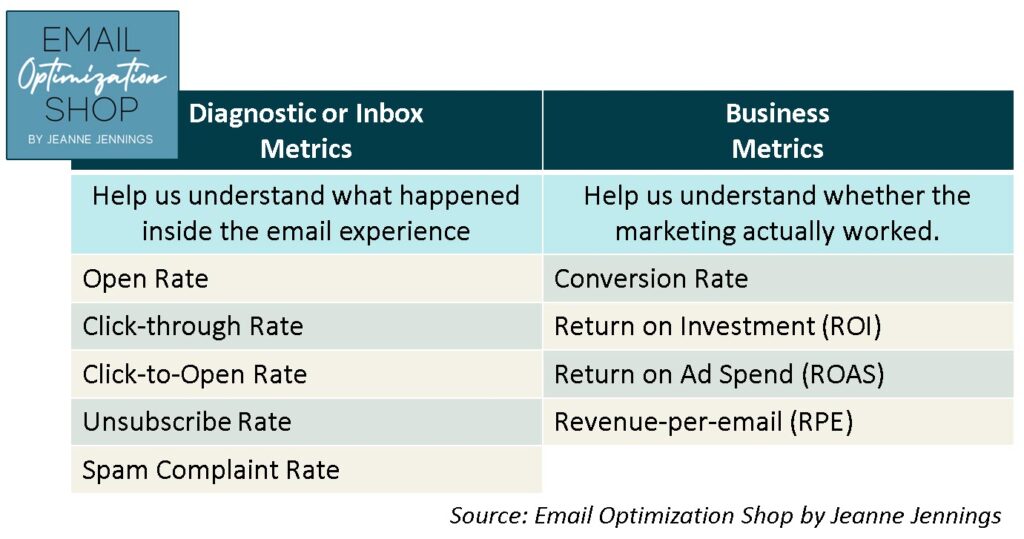
Think about it this way:
Diagnostic or Inbox metrics help us understand what happened inside the email experience.
Business metrics help us understand whether the marketing actually worked.
Those are not the same thing.
Don’t Optimize for the Wrong Trophy
This is especially important right now as AI and automation make it easier than ever to produce and test email variations at scale.
If you optimize the wrong thing faster, you don’t become more strategic.
You just become more efficient at chasing the wrong outcome.
The marketers who will thrive over the next several years are the ones who stay focused on business impact:
- customer behavior
- customer value
- retention
- revenue
- relationships
Not just dashboards full of vanity metrics.
Because at the end of the day, nobody hangs a banner for “Highest Open Rate Q2 2026.”
But revenue growth?
Customer loyalty?
Business impact?
That’s the Stanley Cup.
And that’s the trophy worth chasing.
FAQ
What email marketing metric matters most?
The most important email marketing metric depends on the campaign goal, but it should always connect to business impact; think revenue, conversions, retention, donations, registrations, or pipeline contribution.
Are open rates still useful?
Yes. Open rates are still valuable diagnostic metrics that can help marketers evaluate subject line performance, audience engagement, and deliverability trends. But they should not be the primary measure of campaign success.
Is click-through rate a vanity metric?
Not necessarily. Click-through rate becomes a vanity metric when marketers optimize for clicks without measuring whether those clicks lead to meaningful business outcomes like conversions, revenue, or retention.
Why are vanity metrics dangerous?
Vanity metrics can create a false sense of success. A campaign may generate high opens or clicks while failing to drive revenue, conversions, or customer value. Focusing too heavily on vanity metrics can lead teams to optimize the wrong things.
Until next time,
jj
Jeanne Jennings is the Founder and Chief Strategist at Email Optimization Shop, a boutique consultancy and training organization where she helps clients craft more effective and more profitable email programs.
Learn more at www.EmailOpShop.com and sign up for our free newsletter to get more content like this.
Author’s note: AI tools were used to assist with drafting and editing portions of this article. The analysis and opinions shared here are based on years of working with client email programs, reviewing campaign performance, and probably watching too much hockey.