
There’s a golden window right after someone joins your list. They’re freshly subscribed, curious, and maybe even excited to hear from you (imagine that!).
That moment? It’s called the honeymoon period.
And if you’re not leveraging it with a strategic welcome email, or better yet, a short welcome series… you’re leaving real money (and relationship equity) on the table.
Let me show you what I mean.
The Data: Welcome vs. Manual Sends
This is from a B2C e-commerce client of mine. They sell professional training courses, and they’ve got a good internal email program.
Here are some charts comparing their average performance from manual sends (promotional emails, newsletters, and webinar invites) with the performance of their welcome message. Let’s start with the metrics that really matter – revenue-per-thousand-emails-sent (RPME) and conversion rate from sent (CR).
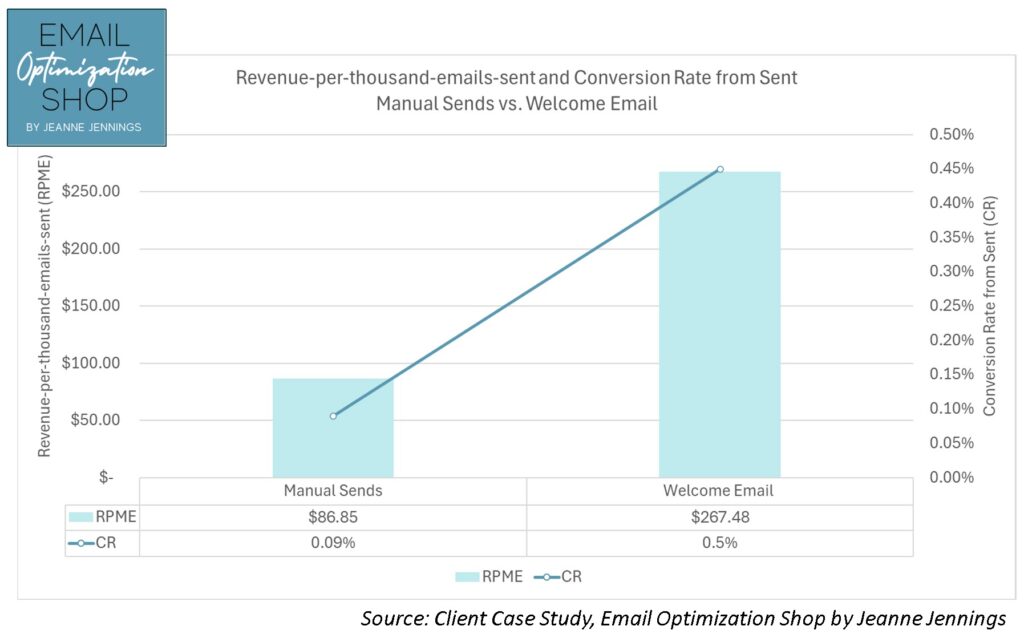
Yes, those are those are the actual numbers.
The RPME of the welcome email is triple that of the manual sends – it’s a lift of 208%, to be exact.
And the conversion rate? There we’re looking at a lift of 400% — it’s about 5 times that of the manual sends.
How about the diagnostic metrics – open and click-through rates (CTRs)…
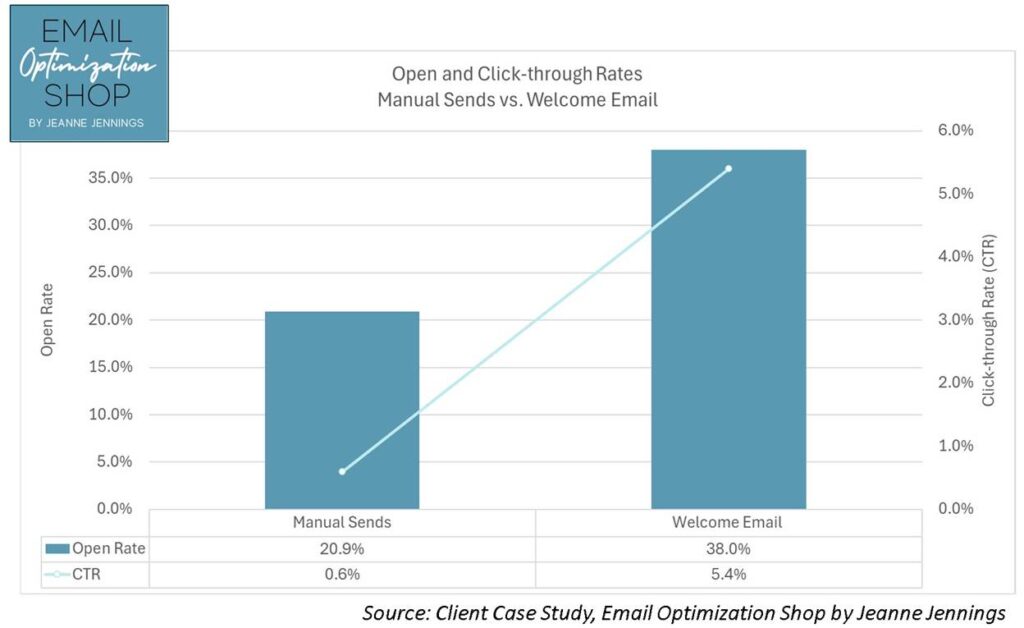
We see similar variances here.
The open rate on the welcome series is 82% higher than that of the manual sends.
And CTR? There the welcome series is besting the manual sends by 800%. Yes, 800%. That’s 9 times as many clicks.
This isn’t an outlier or a one-time promotion. It’s the automated welcome email, which can be the quiet overachiever of your program that never takes a day off.
Why the Welcome Email Crushes It
The welcome message hits at just the right time. Your new subscriber is still warm, still interested, still paying attention.
They’re expecting to hear from you.
They’re open to hearing from you.
And they’re actively wondering if signing up was a good idea.
Enter: a relevant, timely, well-crafted welcome email.
This client’s message worked because it did three key things:
- Delivered immediate value: no bait-and-switch, no vague “thanks for joining.”
- Reinforced expectations: it told people what they’d get next, and when.
- Invited action: clean, scannable layout with clear CTAs and low-friction next steps.
Let’s Talk About Relevance
If your welcome message is a generic “thanks” and a link to your homepage, you’re not just missing an opportunity, you’re starting the relationship on the wrong foot.
During the honeymoon period, your messages benefit from:
- Higher attention levels
- Stronger intent to engage
- Built-in goodwill and curiosity
It’s like showing up to a first date and actually listening, versus diving into a sales pitch about your dog grooming side hustle.
When someone joins your list, they’re telling you: “I’m interested. Tell me more.”
A good welcome message says: “Great. I’m glad you’re here. Let me help you get started.”
Why This Matters (Beyond the Metrics)
I know we all love a good stat, and yes, an RPME of $267.48 is nothing to sneeze at. But this welcome email also laid the foundation for everything that came after.
It didn’t just generate revenue. It set expectations. It increased trust. It helped build a brand relationship that lasted longer than a single sale.
This is where email shines. Not just as a revenue engine but as a relationship-builder.
TL;DR
- Welcome emails outperform regular manual sends across every meaningful metric.
- They arrive during the honeymoon period, when engagement is highest and trust is fresh.
- A single, relevant, well-timed welcome email can generate triple the revenue of standard campaigns.
- If you’re not optimizing your welcome experience, you’re missing the easiest win in your program.
Welcome emails aren’t “nice-to-haves.” They’re performance powerhouses hiding in plain sight.
Need help building or optimizing your welcome strategy? I’d love to take a look, let’s chat.
Until next time,
jj
Jeanne Jennings is the Founder and Chief Strategist at Email Optimization Shop, a boutique consultancy and training organization where she helps clients craft more effective and more profitable email programs.
Learn more at www.EmailOpShop.com

Photo by Maria Lin Kim on Unsplash