
When it comes to the future of email marketing, no single person has all the answers; but a smart community asking the right questions? That’s where the good stuff happens. That’s where you get your 2026 email marketing trends.
So I asked members of our ‘Let’s Talk Email‘ community to share their predictions for 2026; what changes they see coming, what trends they’re tracking, and what might finally (finally!) be on its way out. Eleven experts responded, with insights covering AI & automation, deliverability, lifecycle & strategy, engagement metrics & testing, personalization & data strategy, and more.
You can read their thoughts below. but we’re not stopping there.
You’re invited to join us live for a community conversation on 2026 email marketing trends and what the new year might hold for our industry. It’s not a webinar. It’s a real conversation.
🗓️ Thursday, December 18
🕛 12:00 Noon to 1:00 PM ET
📍 Zoom (cameras on, please!)
💬 Open discussion; bring your questions, hot takes, predictions, and strong feelings about emojis in subject lines.
It’s free to attend. Just request your invite. All are welcome.
Our ‘Let’s Talk Email’ Experts
We asked some of the smartest minds in the business to weigh in on what’s ahead for our industry and they delivered. From AI and deliverability to strategy, testing, and human-centered messaging, these 2026 email marketing trends reflect both experience and vision.
Click on any contributor’s photo to jump to their predictions and explore their take on what matters most in the year ahead.











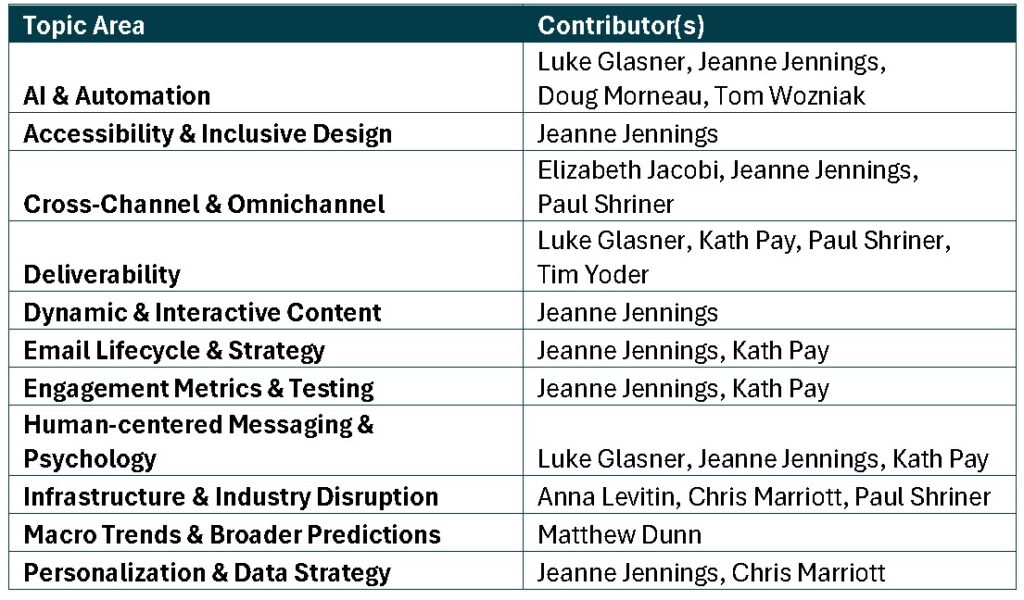
Predictions by Topic Area
Prefer to browse by interest? We’ve grouped all the 2026 email marketing trends into key topic areas, from AI & automation to personalization, deliverability, and more.
Each area highlights which experts weighed in, so you can dive deeper into the predictions that matter most to your role, your team, or your inbox goals for the year ahead.
Predictions
Want to read the full take, no edits, no summaries, just straight from the source? You’ll find that here.
Below are the complete, unedited predictions from each of our contributors. Every one of these experts brings a unique perspective on the 2026 email marketing trends shaping our industry — from big-picture strategy and infrastructure shifts to hands-on tactics around AI, testing, deliverability, and more.
Scroll through (they’re in alphabetical order by last name).

- Apple makes quiet AI acquisition(s) – Mistral, Hume or both.
Apple isn’t missing the AI moment – they’re waiting for it. - Circa September, with the failed launch of their new advertising platform, OpenAI makes an unsuccessful bid for a Federal bailout.
- Iceland announces that data centers make up >7.5% of GDP.
- China ratifies the 15th 5-year Plan but does not invade Taiwan.
Despite plans to increase birth rates, the demographic-curve crisis there worsens. - Stirrings of bipartisan agreement around the failing state of American K12 education start to reach national attention, but without vision, plans or funding.
- News leaks that Google is using Gmail message content to train Gemini.

I predict 2026 will be the year AI moves into more areas of email. So far we’ve seen mass adoption in the industry for creative production, dynamic content, and analytics/reporting. In 2026 we will see AI improve in tackling other areas such as coding, deliverability, more sophisticated segmentation and sending optimization. For some users AI is already being used in these areas but it’s not as good at them as copywriting. I think 2026 will be the year that AI has been trained enough to really code an email or solve deliverability problems.
I also would not be surprised to see less AI driven copywriting as we’re starting to see a bit of a backlash against AI copy. I think too many people thought they could just get away with AI produced content without real people humanizing the content. But now people are realizing that AI cannot replace that human touch that is so fundamental for creative production. As we move forward, it will be content producers and AI working more hand-in-hand with each other, where most work will be a combined effort of AI and Human production.
What I have seen so far is mostly, either too much AI and not enough human feel or only people only playing lip service to AI to toe the line for an industry trend. I think that 2026 will be the year that email marketers learn how to strike that balance between human work vs. AI for campaign production and find the sweet spot that many of us in the industry have been looking for and encouraging other marketers to find for themselves.

My prediction and my hope for 2026 is that we will finally see true synergy between email and SMS. AI will help break down these channels’ long-standing silos by enabling brands to easily create channel-appropriate messaging rather than sending the exact same content.
Email will continue to lead in longer-form storytelling and educational messaging, while SMS will become even more essential for reminders and last-minute alerts. SMS is also an effective way to re-engage subscribers who may have become inactive on the email channel, which is more critical now.
As more platforms offer integrated segmentation and journey design, the synergy between these two retention channels will become more sophisticated than ever. The brands that win in 2026 will not think in terms of “email or SMS,” but will create coordinated customer multi-channel messaging where each channel plays its strongest role.

Jeanne Jennings (me!)
Founder & Chief Strategist
Email Optimization Shop
Reach out to Jeanne on LinkedIn
Let’s cut right to it: the core principles you and I have been talking about for years (relevance, value, and respect for the inbox) aren’t going away in 2026. But the tools and expectations that shape how we deliver on those principles? They’re evolving fast.
Here’s how I see the landscape shaping up, my 2026 email marketing trends, based on where smart programs are already heading and what’s showing up in real performance data.
1. AI Is Everywhere, But It’s Still Just a Tool
Let’s be real: everyone’s talking about AI. And yes, it’s powering subject lines, segmentation logic, and dynamic content in ways we couldn’t do at scale before.
But here’s the important part: AI isn’t strategy. It doesn’t replace knowing your audience and designing experiences that respect their attention. It enhances execution, not strategic thinking. I’ve said this over and over again since AI was first entering the email marketing world, and if you missed my latest post, you can read it here: ‘AI Is a Tool. It’s Not a Strategy. And It’s Why the Fundamentals Matter More Than Ever.’
So in 2026, marketers who treat AI as a means to deepen relevance, not a shortcut around fundamentals, will outperform the ones chasing shiny “AI magic” metrics.
2. First‑Party Data Drives Real Personalization
With privacy changes continuing to erode traditional tracking, first‑party data (for instance, your own subscriber behavior, preferences, engagement signals) becomes your most strategic asset. Unified data platforms are no longer “nice to have.” They’re enablers of:
- Accurate segmentation that actually predicts needs
- Behavior‑triggered journeys that feel 1:1 rather than broadcast
- Better measurement of real business outcomes (not just opens and clicks)
If you’ve read my posts on segmentation frameworks (like ‘The Simple Email Segmentation Framework You Should Be Using’), you know relevance comes from context. Better data lets you actually deliver on that promise.
3. Email + Cross‑Channel Orchestration Is the New Normal
Email alone still beats almost every other channel in ROI; that hasn’t changed. But in 2026, it won’t live in isolation.
We’re seeing email workflows increasingly include email, SMS, web push, and in‑app notifications to:
- Reinforce messages at appropriate times
- Capture timely actions outside the inbox
- Reduce reliance on any one channel alone
The models that do this well treat each channel as part of a cohesive experience, not a siloed tactic, the way a tight message map brings together subject, copy, cadence, and offer. Your nurture series recommendations and message mapping work are already pointing in this direction.
4. Welcome & Lifecycle Series Become the Bedrock of ROI
If there’s one lesson I’d bet against ignorance in 2026, it’s this: never underestimate the honeymoon period.
Welcome emails and nurture flows consistently outperform manual email sends because they arrive when intent is highest and performance lifts aren’t modest; they’re multiples. For example, a welcome series can triple revenue per thousand sends compared to routine campaigns (see ‘Proven Case Study: Why Welcome Emails Outperform and Convert Better’ to learn more).
Lifecycle automation isn’t about automation for automation’s sake. It’s about pairing the right message with the right moment, something any strategist worth their salt has been preaching for years.
5. Engagement Metrics Evolve, But Don’t Forget the Fundamentals
In 2026, metrics will shift further toward outcomes:
- Conversions rather than opens
- Revenue per campaign instead of click‑through rate alone
- Longitudinal engagement instead of one‑off interactions
I’ve starting using 2 new engagement metrics with my clients (learn more in ‘What Your Email Engagement Metrics are Missing – and 2 New Ones that Reveal the Truth’). That said, the fundamentals still matter: clean data, thoughtful segmentation, and strategic testing. We all know that open rates can be misleading and in 2026, that lesson will be even more relevant as platforms continue to mask opens and blur visibility on behavior.
6. Accessibility and Inclusive Design Are Non‑Negotiables
Regulatory pressures and user expectations are pushing accessibility up the priority list. Emails that ignore accessibility not only risk compliance issues, they also degrade engagement for real people who deserve clear, usable content.
Accessibility isn’t a checklist. It’s part of making your email easy to read, useful, and respectful of everyone’s time, the same way good copy and structure support conversion. That’s been core to my guidance to clients for years.
I teach web accessibility in my digital marketing class at Georgetown University; here’s a great place to start: Introduction to Web Accessibility from the Web Accessibility Initia6tive (W3C). For email-specific accessibility information, Sarah Gallardo is my favorite source; here’s her blog.
7. Dynamic & Interactive Content Becomes Table Stakes
Dynamic content, whether it’s update‑on‑open offers, live countdowns, or content blocks that react to user behavior will go from “some programs” to “most programs” by the end of 2026.
But here’s the real test: it shouldn’t be flashy for flashiness’s sake. It should be functional, improving relevance, reducing friction, and helping subscribers get what they need faster.
8. Authenticity & Value First Messaging Wins Loyalty
Finally, as inboxes get more crowded, authentic value trumps aggressive frequency.
I’ve written about how frequency without strategy becomes noise (see ‘When A Brand Mistakes Email Frequency for Strategy’), and that holds. Sending more emails doesn’t equal more revenue if those emails don’t respect where your audience is on their journey.
Every message in 2026 must earn its place:
- Does it help the reader?
- Is it relevant and timely?
- Does it reduce friction toward a goal?
If the answer is “no,” it shouldn’t be in the schedule.
What do you think of my predictions? What 2026 email marketing trends did I miss?

Before we even talk about AI, 2026 is already shaping up to be a year of massive shifts in email. Industry consolidation, acquisitions, and old platforms quietly sunsetting will reshape the landscape. Inbox providers will keep tightening their rules, adding new limits that will force email marketers to rethink long-held habits.
And then comes AI, bringing both benefits and challenges.
On the good side: AI will finally make data and analytics accessible for the everyday marketer. Most of us operate like a one-person band, and getting clean, connected data will be simpler. With better integration and smarter automation, AI will remove a lot of that friction and give us the kind of visibility we’ve been begging for.
On the bad side: AI-powered inboxes will rewrite our emails, preheaders might disappear as well. That means some of our traditional tactics will lose influence and we’ll have to rethink how we capture attention.
2026 will be a year of uncomfortable changes. Some will feel wrong, unnecessary, or just frustrating. But they mark the beginning of a new reality. And the marketers who accept it early and build for it will be the ones who work smarter and succeed faster.

1. The Coming Wave of ESP RFPs
2026 will usher in a significant spike in ESP RFP activity, driven not by curiosity but by necessity. Brands still clinging to legacy platforms such as Oracle/Responsys and Salesforce Marketing Cloud will finally acknowledge that the familiar strategy of “just one more contract extension” is no longer a defensible path.
For Oracle clients, the writing on the wall will become impossible to ignore: Oracle is methodically stepping away from the email business, investing little, sunsetting quietly, and making clear through its product behavior (if not its public statements) that email is no longer part of its future roadmap. No marketer wants to be the last tenant in a building where the lights are already being turned off floor by floor. The reputational risk alone will push many to market.
Salesforce clients will face a different but equally unavoidable truth. The hope that one more extension will “buy time” is evaporating as Salesforce continues to force an uncomfortable and expensive transition to SFMC Next. Brands will realize that delaying the pain does not eliminate it — it merely reduces their leverage and compresses their migration window. By mid-2026, many enterprises will decide that if they must migrate, they might as well evaluate all modern contenders rather than blindly follow Salesforce into the unknown.
In short:
2026 is the year when postponement becomes untenable — and the RFP becomes inevitable.
2. CDPs will continue their steady slide into irrelevance
Not because the idea was wrong, but because the execution never matched the promise. Brands invested heavily in platforms that were supposed to unify data, power personalization, and orchestrate the customer journey — only to discover that the CDP became yet another expensive data warehouse adjacent to the systems that actually do the work.
As messaging platforms, cloud data warehouses, and identity solutions have absorbed the core functions CDPs once claimed as exclusive, the standalone CDP has been left in an awkward middle ground: too technical for marketers, too limited for engineers, and too duplicative for finance. The center of gravity has moved to zero-copy execution models, native warehouse activation, and AI-driven decisioning inside the messaging layer, not in a separate, slow, expensive platform sitting upstream.
In short:
The CDP isn’t dying; it’s simply being absorbed by more capable systems that deliver real outcomes instead of just tidy data tables. And as this consolidation accelerates, the standalone CDP will increasingly resemble the Blackberry circa 2012: still present, still defended by loyalists, but very clearly on the wrong side of history.

In 2026, the most valuable email data won’t come after the opt-in — it will come before it.
For the first time in the history of email marketing, AI is giving us full visibility upstream — before anyone ever joins a list. AI-driven chatbots are capturing the real questions visitors ask, the problems they’re trying to solve, the friction they hit, and the outcome they’re chasing.
Then if used, enrichment will complete the picture: who they are, where they’re from, their role, buying power, and behavioral context.
And when they request a transcript — which nearly all of them do — that intent-rich narrative is automatically paired with an email address.
This flips the funnel.
Email marketers will know more about a prospect before the opt-in than they’ve ever known after it.
Used correctly, this collapses the buyer journey, eliminates guesswork, and helps people reach their goals faster and with fewer resources.
AI automation isn’t another tool in the stack — it becomes the infrastructure of customer understanding.

1. Zero Click Behaviour Forces a Rethink of Attribution
My prediction: Zero click behaviour does not mean we stop directing people to landing pages or product pages.
It means accepting that consumers do not move in neat, trackable lines.
People browse anonymously, dip in and out, search in app, and make decisions long before we ever see a click.
So yes, we will still drive traffic. We just will not be able to track it with the same precision and that is fine.
In 2026, the smartest marketers will acknowledge that consumer behaviour has changed and adjust their expectations around attribution.
Rather than obsessing over proving every conversion, we will shift toward demonstrating influence, building strong behavioural signals, and creating emails that move people closer to a decision even when the click does not get the credit.
Attribution will not collapse. It will evolve, just as we must.
2. Testing Becomes a Non-Negotiable Skill
My prediction: Guessing will finally run out of road.
As attribution keeps collapsing and data gets noisier, the only thing that will cut through is proper hypothesis led testing.
Holistic Testing moves from a nice idea to how you stay employed.
Brands that test well will accelerate.
Everyone else will still be debating button colours in Q4.
3. Deliverability Walks Into the Boardroom
My prediction: Deliverability will become a strategic KPI, not a technical afterthought.
With inbox providers tightening filtering and engagement becoming highly visible, brands will suddenly realise they have been talking to lists that are not actually reachable.
Leaders will finally invest in fixing it.
4. The Email Marketer Evolves Into a CRM Strategist
My prediction: The classic “Email Marketing Manager” role will dissolve into more strategic, multidisciplinary titles: Lifecycle Architect, Retention Strategist, CRM Intelligence Lead.
Sending emails will be automated.
Human marketers will instead orchestrate journeys, analyse behavioural patterns, craft hypotheses, and balance persuasion with timing and relevance.
Creating meaningful communication becomes the human’s job.
It is not the end of email marketing. It is the evolution of it.
5. Psychology Goes Mainstream
My prediction: 2026 is the year psychology stops being a bonus and becomes the expectation.
Buyer modalities, cognitive biases, and design-for-decision techniques will appear in briefs, not just conference talks.
The Holistic Persuasion Framework becomes the reference point for writing emails that convert.
If you are not designing for how the brain really makes decisions, you will be left behind.
6. Strategy Becomes the Ultimate Differentiator
My prediction: 2026 exposes the biggest truth in our industry. Most brands still do not have a real email strategy.
As privacy tightens and data shrinks, you will not be able to hide behind business as usual.
Clear objectives, journeys, hypotheses, and measurement frameworks will separate the winners from the ones still chasing open rates.
Strategy stops being optional. It becomes the entire game.

- More moves in the M&A game, one of the new-gen ESPs will get purchased
- Brands will be able to pay for better deliverability (maybe crypto)
- Fewer silos, more omnichannel (Thanks AI)
- Cloudflare will enter the transaction email space and will have a major impact on services like Send Grid and Synch.

AI won’t make a huge impact on the marketing and email job market in 2026 (beyond what it already has). The disruption is definitely coming, but it isn’t going to show up quite as fast as the optimists (or would it be pessimists?) have been predicting. This really applies to the job market in general. It reminds me of various major disruptive innovations in the past where the predictions tended to come in early, and the reality was it took more time (The Year of Mobile… which was predicted from 2007-2014. HDTV – which was being talked up in the early 1990s, yet it didn’t become the industry standard until 2009.) AI is going to follow a similar path toward massive market dominance and disruption. So, don’t expect a superintelligence to introduce itself to the world in 2026.

Within the next year, Google and Yahoo will start to require MTA-STS alongside DKIM, DMARC, SPF to ensure delivery to their platform.
Thanks!
Big thanks to everyone who contributed to this year’s predictions, and to you for reading them. But the real power comes from what we build together.
Whether you’re nodding along, skeptical, or ready to call your ESP and switch platforms tomorrow… we’d love to hear from you.
👉 Join us live on Thursday, December 18 at 12:00 PM ET for a candid, cameras-on discussion on 2026 email marketing trends with these experts and smart, curious email pros just like you.
Request your invite today. And bring your questions, your perspective, and your own bold predictions for 2026 email marketing trends.
Let’s talk email.
jj