
From Apple Mail Privacy Protection to AI-generated inbox summaries to Google’s new program for political email, major decisions are reshaping email marketing, often without much input from the people who work in the channel every day. It may be time for email industry advocacy to become a bigger priority, so senders, recipients, and the long-term health of email have a stronger voice when the rules change.
Twenty years ago, I wrote a two-part ClickZ column titled Political Candidates, Known Spammers, and CAN-SPAM. Part 1 was a personal case study — and Part 2 provided prescriptive steps that political organizations and others could use to protect themselves from situations like this.
Yes. Twenty years ago.
So imagine my reaction when I read a New York Times article this week about Google’s new program designed to make it easier for political campaigns, parties, and PACs to get their fundraising emails into Gmail inboxes.
For those of us who make a living in email marketing, there’s a lot to unpack here. Political email already gets a break that commercial email doesn’t: CAN-SPAM regulates commercial email, while political email falls outside those requirements.
And now political senders may get another advantage: a special program intended to make it easier for their messages to bypass Gmail’s spam folder.
Why?
But the more I thought about this, the more I realized that isn’t the only question bothering me.
Where is the email industry in this conversation?
And not just this conversation.
Let’s Go Back to 2006
In 2006, I received a political email that I had never requested. That was odd enough, so I started investigating.
The organization told me it had purchased a list supposedly made up of people who belonged to the candidate’s political party, lived in the candidate’s district, and had voted in one or both of the previous primaries.
I met none of those criteria. I lived more than 500 miles away, I wasn’t affiliated with the party, and I obviously hadn’t voted in those local primaries.
Even better, the email was sent to an address I didn’t use to subscribe to things. It was an address I had published in my ClickZ columns so readers could contact me.
Then I researched the IP address the email was sent from. There were spam complaints. There were blacklisting issues. There were indications that email addresses had been harvested.
None of this looked especially good.
And yet the political campaign apparently hadn’t violated CAN-SPAM, because CAN-SPAM applies to commercial email. Political email is different.
I wrote about that in 2006. And apparently, here we are again.
What Google Is Changing
According to The New York Times, Google has created a program that will allow verified candidates, political parties, and PACs to more easily get their fundraising emails past Gmail’s spam filter. The program is scheduled to begin September 8, ahead of the 2026 midterm elections.
Political senders won’t simply get a free pass. They’ll have to meet Google’s requirements, including registering the domains they use for email and keeping the percentage of recipients who mark their messages as spam below 0.3%.
That requirement is important. But the larger concept still bothers me: why should political email need a special path into the inbox at all?
Legal Does Not Equal Wanted
There are three separate questions that tend to get mixed together in discussions like this:
- Is the email legal to send?
- Does the recipient want it?
- Should the mailbox provider put it in the inbox?
Those are not the same thing.
CAN-SPAM deals with the first question. Deliverability deals, in large part, with the other two.
Commercial email marketers know this very well. You can comply with every provision of CAN-SPAM and still end up in the spam folder, because compliance is not an inbox-placement strategy. It’s the floor.
Responsible email marketers have spent decades building programs around permission, subscriber expectations, engagement, reputation, authentication, and complaints. We don’t get to demand inbox placement simply because we’re legally allowed to send an email.
Why should political senders?
What Happened to Email Industry Advocacy?
And this is where my thinking about this article changed.
The more I thought about Google’s political-email decision, the more I realized that my frustration isn’t limited to political email.
Think about what’s happened to email in just the last few years.
Apple introduced Mail Privacy Protection, fundamentally changing the meaning and usefulness of the open rate for a significant portion of many email lists. Apple describes MPP as a privacy feature that prevents senders from learning information about a recipient’s Mail activity; it does this in part by downloading remote content in the background regardless of whether the recipient engages with the message.
That was a major change to a metric email marketers had relied on for decades.
More recently, AI-generated inbox summaries created by inbox providers have begun replacing, or at least competing with, the carefully crafted preview and preheader copy marketers create to help recipients decide whether to open an email.
Again, that’s not a small change. It’s a third party using AI to interpret our message and presenting its version to the recipient before the recipient sees ours.
Now we have a special Gmail program for political email.
These are very different developments. I’m not suggesting they’re equivalent, or even that they’re necessarily bad.
What they have in common is that other organizations are making decisions that materially change the email experience for senders and recipients.
When you put some of the major changes of the last two decades on a timeline, the pattern becomes pretty striking.
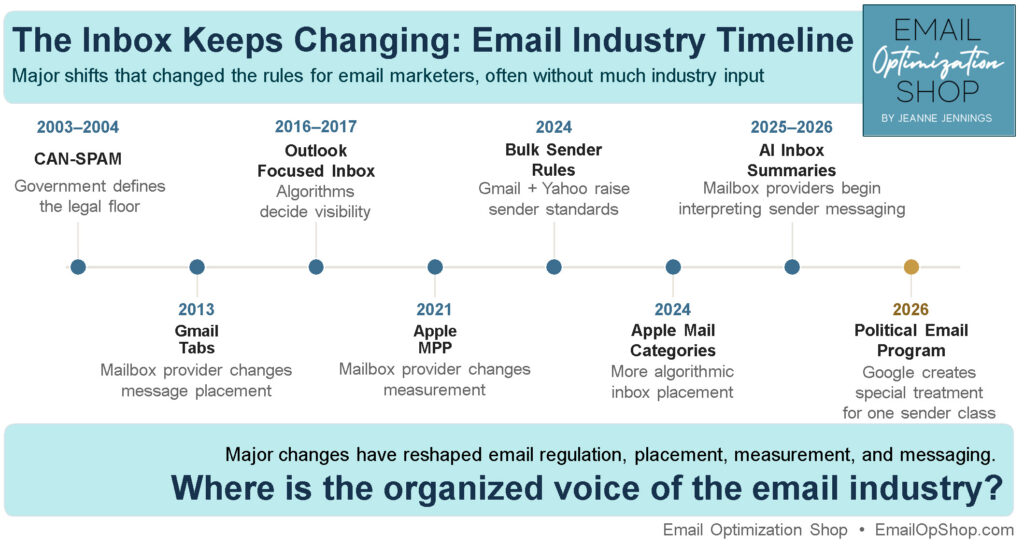
Looking at that timeline, I keep coming back to the same question: when did email industry advocacy go so quiet?
We’ve Had an Industry Voice Before
I remember the debates leading up to CAN-SPAM.
The Direct Marketing Association (DMA; now part of the Association of National Advertisers) was an active voice in Washington during the development of email regulation.
I didn’t always agree with the email industry advocacy positions our organizations took. In particular, I believe opposing an explicit opt-in standard was shortsighted. More than two decades later, we’re still dealing with the consequences of having a U.S. email law that establishes a much lower bar than the permission practices responsible email marketers actually recommend.
In fact, when CAN-SPAM took effect in 2004, I wrote a 10-point compliance checklist for ClickZ. Even then I noted that many of the legal requirements were already second nature to opt-in email marketers.
That’s an important distinction: what the law permits and what responsible email marketing requires have never been exactly the same thing.
And as far as I know, no major industry organization mounted a meaningful challenge to the exclusion of political email from CAN-SPAM.
Perhaps we should have.
I may not have agreed with every position the DMA took back then, but at least the industry was at the table.
I’m not sure we are today.
Who Should Lead Email Industry Advocacy?
So if we agree that email industry advocacy is needed, who should be doing it? It’s not that we lack organizations that could convene these conversations.
We have the Messaging, Malware and Mobile Anti-Abuse Working Group (M3AAWG), which brings together mailbox providers, senders, ESPs, security companies, and others to develop technical and operational best practices. Google is a Sponsor member, as are Microsoft, Yahoo, Constant Contact, Mailchimp, and others; Apple is also a member.
M3AAWG isn’t a lobbying organization, and I don’t think it should suddenly become one. But it is one of the rare places where senders and mailbox providers are already at the same table. If we’re going to have a serious industry conversation about when one class of sender should receive special inbox treatment, that seems like a pretty good table to use.
We have the Email Sender & Provider Coalition (ESPC), whose work explicitly includes public policy, deliverability, compliance, and changes in email handling at major receivers. Its members include companies responsible for a significant portion of commercial email delivery.
And we have the ANA Email Excellence Center, which describes its mission as being the voice of the email marketing community and advocating ethical email marketing best practices and technologies. (Full disclosure: I was an active board member here for many years.)
That word, voice, is important.
Because I think we need one.
I Tried to Build One Once
Some longtime readers may also remember Only Influencers, the email marketing community I led for a number of years (Rising Media was the owner of the organization).
At one point, I seriously considered expanding Only Influencers beyond education, discussion, and community and moving into email industry advocacy. Being based in Washington, DC certainly made the idea tempting.
I never did it.
There were practical reasons, as there always are. Advocacy takes money, infrastructure, consensus, and a willingness to spend political capital. Running a vibrant professional community was already a significant undertaking.
But lately I’ve found myself thinking about that decision again.
Maybe what I was sensing then is even more important now.
We have plenty of places to talk to each other about what’s happening to email.
What I’m less sure we have is an effective mechanism for speaking for the industry when decisions that fundamentally affect the channel are being made.
And Who Is Speaking for the Recipient?
There’s another constituency here that I think gets lost.
The recipient.
Senders have business interests. Mailbox providers have business interests. Platforms have business interests. Political organizations certainly have interests.
But the inbox belongs, ultimately, to the person using it.
That’s why spam complaints matter. When someone clicks “Report spam,” they’re telling the mailbox provider something. Maybe they never asked for the email. Maybe they don’t recognize the sender. Maybe the frequency is too high, the content isn’t relevant, or the sender has simply worn out their welcome.
Whatever the reason, it’s feedback.
The principles our industry has spent decades developing — permission, transparency, relevance, preference, authentication, reputation — aren’t just there to make marketers’ lives difficult.
They help maintain trust in email.
That trust is why email continues to work.
What Email Industry Advocacy Could Look Like
I’m not suggesting our industry take a Republican position or a Democratic position on Google’s new program.
I’d like us to take an email position.
Should bulk political senders be expected to follow the same responsible sending practices we ask of other bulk senders?
Should permission and subscriber expectations matter?
Should recipient behavior continue to be a meaningful factor in determining inbox placement?
Should mailbox providers create exceptions for particular categories of senders? If so, under what circumstances?
What should happen when changes to the inbox, whether driven by privacy, AI, filtering, or something we haven’t encountered yet, materially alter the relationship among sender, mailbox provider, and recipient?
And perhaps most importantly: who gets a seat at the table when those decisions are made?
To me, that’s what email industry advocacy should look like. Not demanding that marketers always get their way, but making sure the expertise of the people who understand this channel — including the needs of recipients — is represented when consequential decisions are being made.
I’d like M3AAWG, the ESPC, and the ANA Email Excellence Center to have this conversation, with their members and, where appropriate, with Google, Apple, Microsoft, Yahoo, and other companies shaping the inbox.
Not after the decisions are made.
Before.
Why the Email Industry Needs a Stronger Voice
The email industry has spent decades developing standards and best practices intended to make email work better for everyone involved.
Senders benefit when people actually want their messages. Mailbox providers benefit when users trust their inboxes. Recipients benefit when they have meaningful control over what lands there.
Yet increasingly, some of the most consequential decisions affecting email marketing aren’t being made by email marketers.
They’re being made by technology companies, mailbox providers, legislators, regulators, and now AI systems.
That’s inevitable. Email doesn’t belong to marketers, and we shouldn’t expect to control every decision that affects the channel. But that doesn’t mean marketers and the broader email ecosystem shouldn’t have a voice when those decisions are being made.
Twenty years after I first wrote about political email and CAN-SPAM, I’m wondering whether it’s time for our industry to find that voice again.
We won’t always agree. We shouldn’t always agree. And sometimes the position that benefits senders won’t be the position that’s best for recipients or for the long-term health of email.
That’s okay.
Having an industry voice isn’t about always getting our way.
It’s about being at the table.
So here’s my question for M3AAWG, the ESPC, the ANA Email Excellence Center, and the rest of us who make our living in this industry:
Who’s ready to pull up a chair? And how can I help?
Until next time,
jj
Jeanne Jennings is the Founder and Chief Strategist at Email Optimization Shop, a boutique consultancy and training organization where she helps clients craft more effective and more profitable email programs.
Learn more at www.EmailOpShop.com and sign up for our free newsletter to get more content like this.
Author’s Note
I believe in being transparent about my use of AI.
I used ChatGPT to help organize my thoughts, conduct background research, and develop an early draft of this article. The opinions, perspective, and final editorial decisions are mine.

Photo by Phillip Goldsberry on Unsplash