
This may seem like a limited use case, but there are lessons here for every email you send…
How does your organization handle email addresses in your database where there’s some relationship to your brand, but not an explicit opt-in? Maybe your sales team met leads away from the booth and got business cards but not an explicit opt-in. Or maybe they purchased your product through a third-party and there wasn’t an explicit opt-in for your organization to mail them directly.
If you’re in the United States, you may just mail them; it’s not illegal under the U.S. Controlling the Assault of Non-Solicited Pornography and Marketing (CAN-SPAM) Act as long as each marketing email includes an unsubscribe.
But just because you can do it does not mean you should. And if you’ve got subscribers in the European Union, Canada, or other countries with stronger regulations about email, this approach won’t keep you on the right side of the law.
This situation is what the European Union’s General Data Protection Regulation (GDPR) calls “legitimate interest.”
‘Legitimate Interest’ is a situation outlined in GDPR which allows brands to send email messages to those who have a ‘legitimate interest’ in what the company is offering, even though there’s no opt-in consent (read: opt-in). The Canadian Anti-Spam Law (CASL) has a similar provision. The gist of both: you have permission to send to them for a limited time – but during that period you much collect an explicit opt-in.
That’s what this email was created to address.
The Original Version of the Email
Here’s the original email, anonymized to protect the brand:
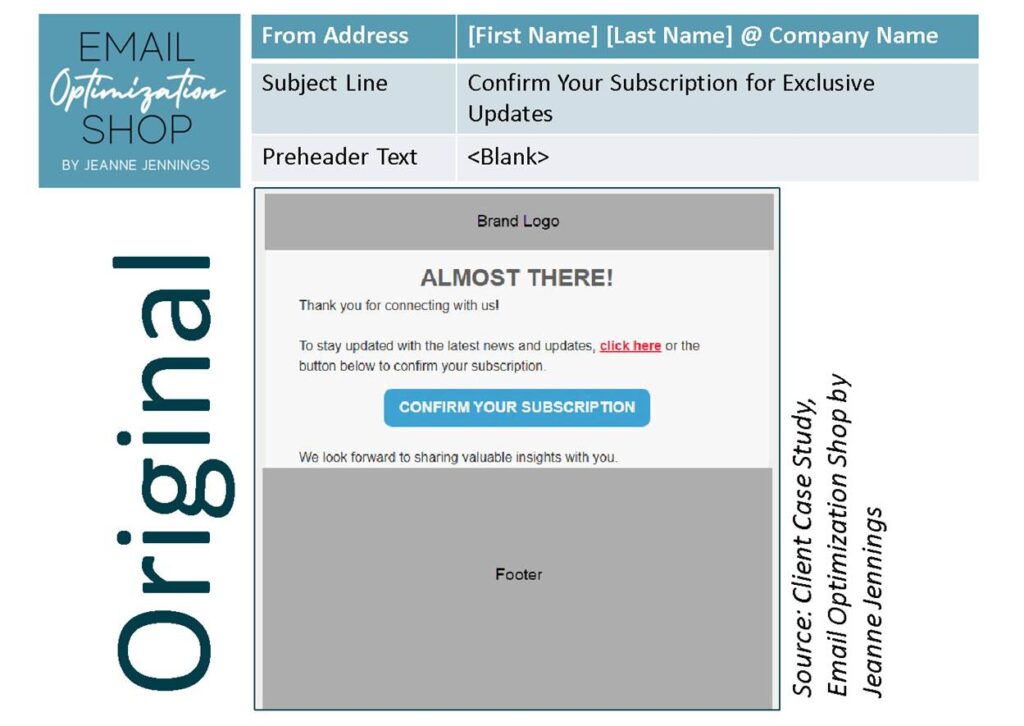
Functional right? It’s very straight-forward, to the point.
But does it get the job done?
Short answer: No. No one converted by confirming their subscription.
So we optimized it with the goal of increasing the conversion rate.
The Optimized Version of the Email
Here’s the new version, again anonymized to protect the brand:
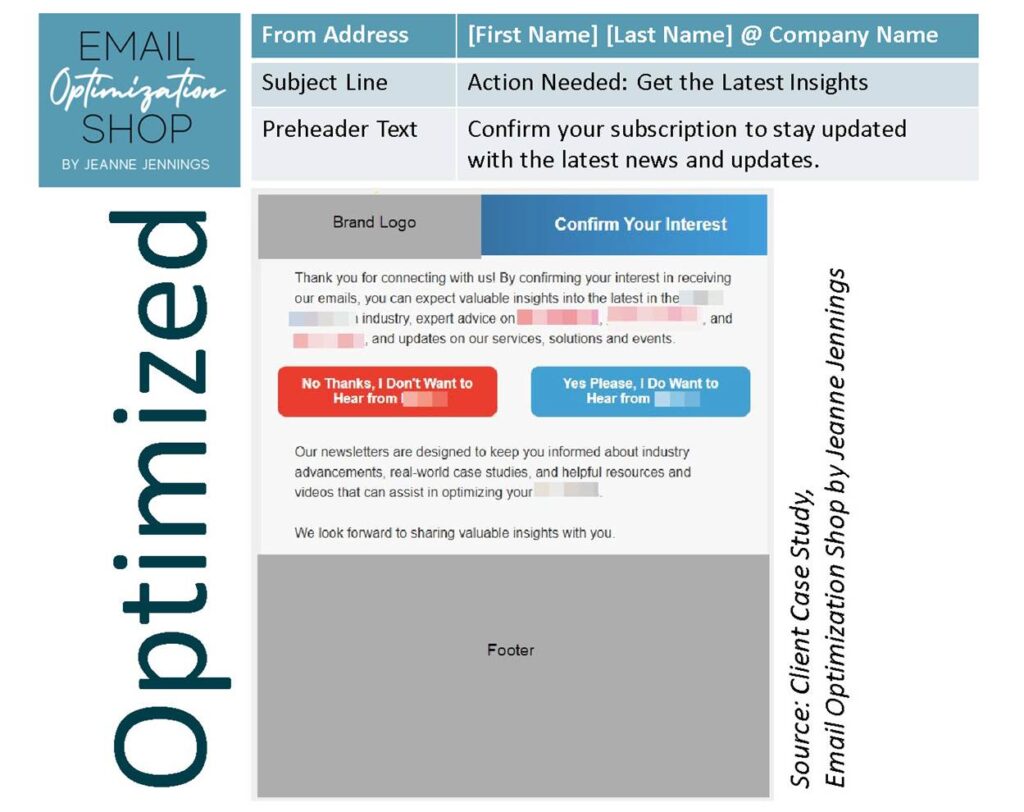
What we did:
- Added urgency and benefit to the subject line (“Action Needed: Get the Latest Insights”)
- Used the preheader text to support the subject line (it was blank in the original)
- Added a headline (“Confirm Your Interest”) to the top to direct the reader to the calls-to-action (CTAs)
- Added benefit-oriented language about what type of content the reader would receive.
- Added a second button, driving the reader to make a choice – in testing I’ve done with opt-in landing pages and emails like this, we usually get higher conversion rates when we offer a choice instead of just a single button.
- Included more benefit-oriented language after the buttons
Everything else remained the same.
The Results
Which version do you think performed better? And, to take it a step further – what was the lift/loss?
Drumroll please…
Our Key Performance Indicator was conversion rate, with conversion defined as choosing one of the two options (either “No Thanks…” or “Yes Please…”)
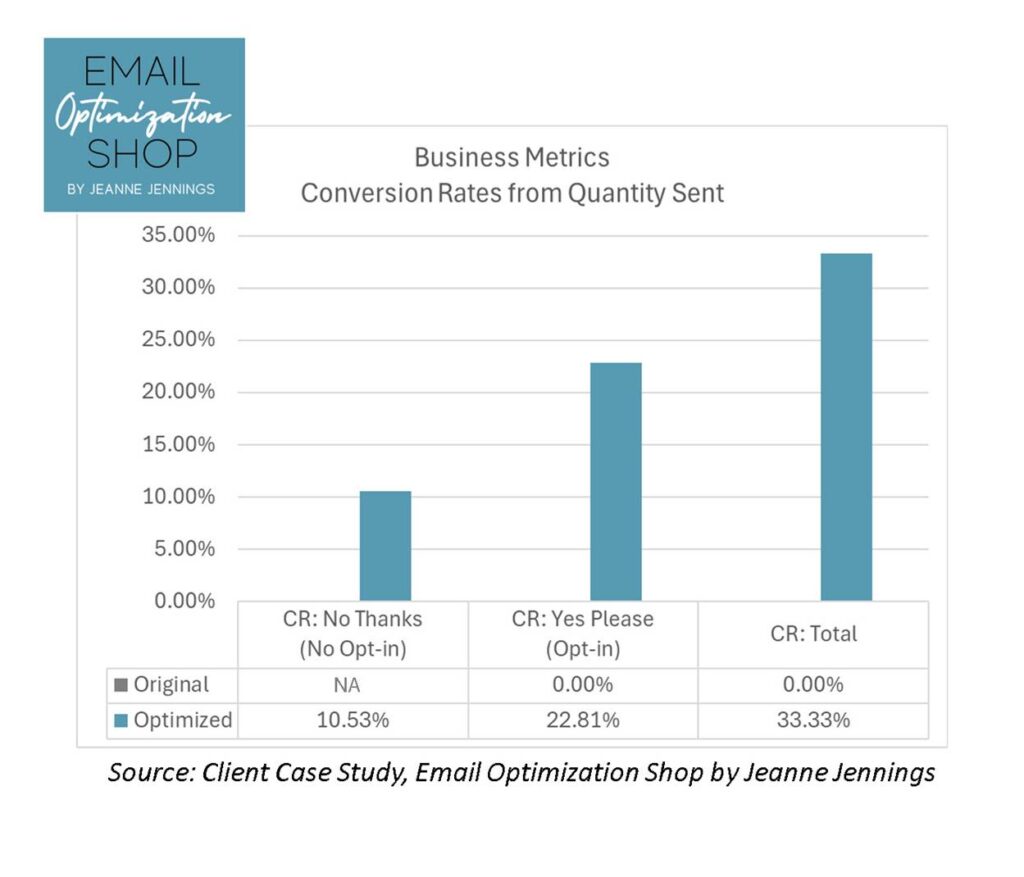
You’re reading that right. We went from no one clicking the button to 33% of the audience clicking one of the two buttons. I’d provide you with a lift/loss figure, but it’s difficult to calculate when the control is zero; ∞% is often listed as the lift, but that seems a little silly…
Even better news – nearly 23% of those who clicked chose to opt-in to future email communications with the “Yes Please” button. Roughly 10% chose the “No Thanks” button – which means we can remove them from our list, they aren’t interested in hearing from us.
Truth: the result was better than I had anticipated.
The sample sizes were small – but the results were outside the margin of error, making them statistically significant.
If we look at the diagnostic metrics we can begin to hypothesize what caused the increase.
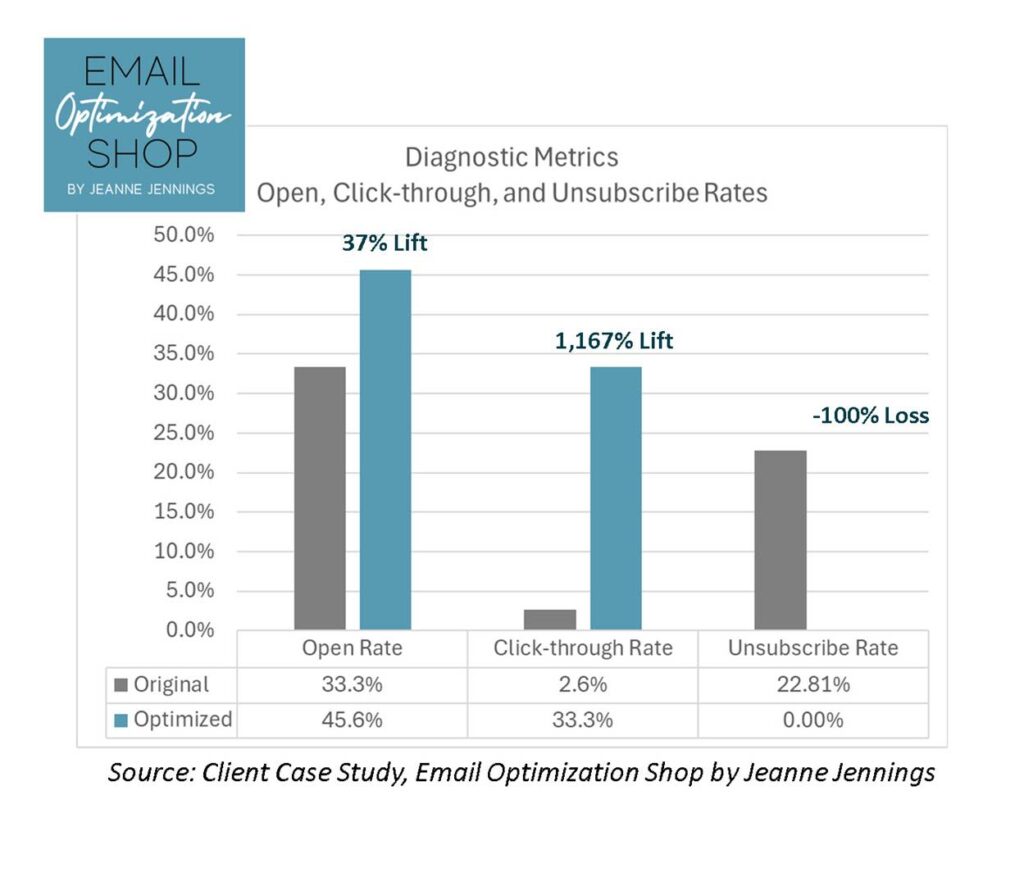
As you can see, we got a 37% lift in open rate; I attribute that to the additions of urgency and benefit to the subject line, as well as better use of the preheader text space.
We also got a large boost in the click-through rate; my hypothesis here is that the headline and benefit-oriented information we added drove this, along with the inclusion of the additional button.
Another benefit of the new version – no one clicked the unsubscribe link – not one person. Now I hear you – that’s because they did not have to, the “No Thanks” button accomplished the same thing – and it was much more prominent.
But even when we compare the original version’s unsubscribe rate (roughly 23%) to the clicks/conversions for the “No Thanks” button in the optimized version (roughly 11%) we see an improvement of 50%.
Further Optimization
So are we done? Well… the client is happy, so we probably are.
But this is one of those creatives where not all of my ideas made it into the final product.
I don’t know if it would further improve performance, but if I were the program owner I would:
- Remove the links in the benefit-oriented copy
- There was one link in the original (which led to the same place as the button
- The optimized version included 3 links, which led to the brand’s key product areas
- None of these text links got significant clicks – which is not surprising – so they aren’t distracting people from the task at hand, but they also aren’t helping. So I’d remove them
- Add a privacy statement
- Something like “We respect your privacy; we don’t sell or share your email address with third parties.”
- If someone is concerned about this, this should alleviate their concerns and ease that friction
- Make the “Yes Please” button green
- Blue is a cool color, it tends to depress action
- Green tends to catch the eye and drive engagement
In Conclusion
As I mentioned, this specific situation is a very limited case – but the changes we made to optimize are worth testing any time you’re looking for a Yes or a No answer.
Give it a try and let me know how it goes!
Until next time,
jj
Jeanne Jennings is a recognized industry expert, consultant, trainer, speaker, and author on email marketing strategy and tactics. In 2001 she founded Email Optimization Shop, a boutique email marketing consultancy; she is their lead strategist. Email Optimization Shop helps organizations make their email marketing more effective and more profitable. Learn more at www.EmailOpShop.com.

Photo by HI! ESTUDIO on Unsplash