
AI is a tool. In February of 2023, back before ChatGPT had really hit the mainstream, I was speaking at the Email Evolution Conference, hosted by the ANA. My session was on A/B split testing, with no mention of AI. It was still early days, people were talking about AI, but in very broad, abstract terms.
After the session, a man came up to me and said, “Great presentation. But I think you won’t be doing this much longer.”
I asked why.
He shrugged and said, “Because of AI.”
That was his entire explanation. As I pressed him, he eventually explained: AI would soon be able to tell us exactly what messaging would resonate with each audience, so there’d be no need to test anything. AI would just… know.
Now, I’m all for using AI to make our work faster and smarter. But ‘AI just knowing’ isn’t how this works.
So let me say it plainly:
AI is a tool. That’s it.
A powerful tool? Absolutely. But not a strategy. Not a value system. And definitely not a substitute for good marketing judgment.
It won’t know what’s right for your audience unless you tell it.
Feed it the right data, give it context and guardrails, and yes, it can help you spot patterns you might not have seen. But left on its own? It’s just math. Fast math. Not insight.
It doesn’t know your audience. You do.
It won’t teach you how to build trust. And it’s definitely not going to save you from a bad customer experience.
What will? The same fundamentals that have always mattered: consent, compliance, and trust.
The more things change…
There’s a lot of noise right now about AI “revolutionizing” marketing. And yes, the tech is evolving rapidly. But here’s the thing:
The more things change, the more the fundamentals matter.
At its best, AI helps us scale the good stuff. Things like smarter segmentation, better timing, more dynamic personalization. It lets us do what we already know how to do, but faster and more efficiently. And that’s valuable.
But it’s only valuable if your foundation is solid.
AI might be able to optimize a subject line. But if you’re emailing people who never asked to hear from you, you’ve already broken the relationship.
AI can recommend products. But if it’s pulling data your audience didn’t knowingly give you, that “personalization” starts to feel a little invasive.
In other words: AI makes your marketing more of what it already is.
If your strategy is good, it can help you scale.
If your strategy is shaky? It’ll just speed up the mess.
AI is a tool; it’s not your strategist
I was speaking to a colleague recently and their answer to almost everything was “We’re letting the algorithm decide.” I had to stop myself from visibly reacting. Because that’s exactly what we shouldn’t be doing.
AI can spot patterns. It can synthesize inputs across massive datasets. But it doesn’t understand brand nuance. It doesn’t know your audience’s history with your company. It doesn’t get your mission, your values, or your voice.
It doesn’t know your customer like you do.
Which means that while it’s tempting to hand over the keys, especially when every martech vendor promises “smarter automation,” the truth is this: AI can only enhance a strategy that already exists.
It can’t build one for you. That part still takes people.
Relationships > Recommendations
Marketing is a relationship.
Always has been. Always will be.
And just like in real life, if you push too hard or violate trust, people opt out. Literally or figuratively.
The brands that will thrive in this AI-powered era are the ones that keep their focus on the audience: on building trust, delivering value, and being transparent. They’ll use AI to make that easier, faster, more scalable. But they won’t lose sight of the fundamentals.
Because the fundamentals are the strategy.
So yes, the tools are evolving. But the playbook? The playbook is still the same:
- Respect your audience.
- Be transparent.
- Add value, consistently.
- Use AI to help you do those things better — not to skip them altogether.
Bottom line? AI is a tool.
AI is here to stay. So is your judgment.
Use AI as a tool, but don’t delegate your program to it.
Learn More and Keep the Conversation Going
If this resonated with you, here are a few next steps to keep learning and stay in the loop:
Want more content like this?
This post kicks off a short series on how to use AI responsibly and effectively in your email marketing.
Sign up for my newsletter
so you don’t miss the next ones!
Curious about what other marketers are doing with AI right now?
I’ll be speaking on a panel about consent, compliance, and trust in the age of AI at the MarTech Conference on November 4.
It’s free!~ Reserve your spot here.
Want to learn how to actually use AI in your email marketing?
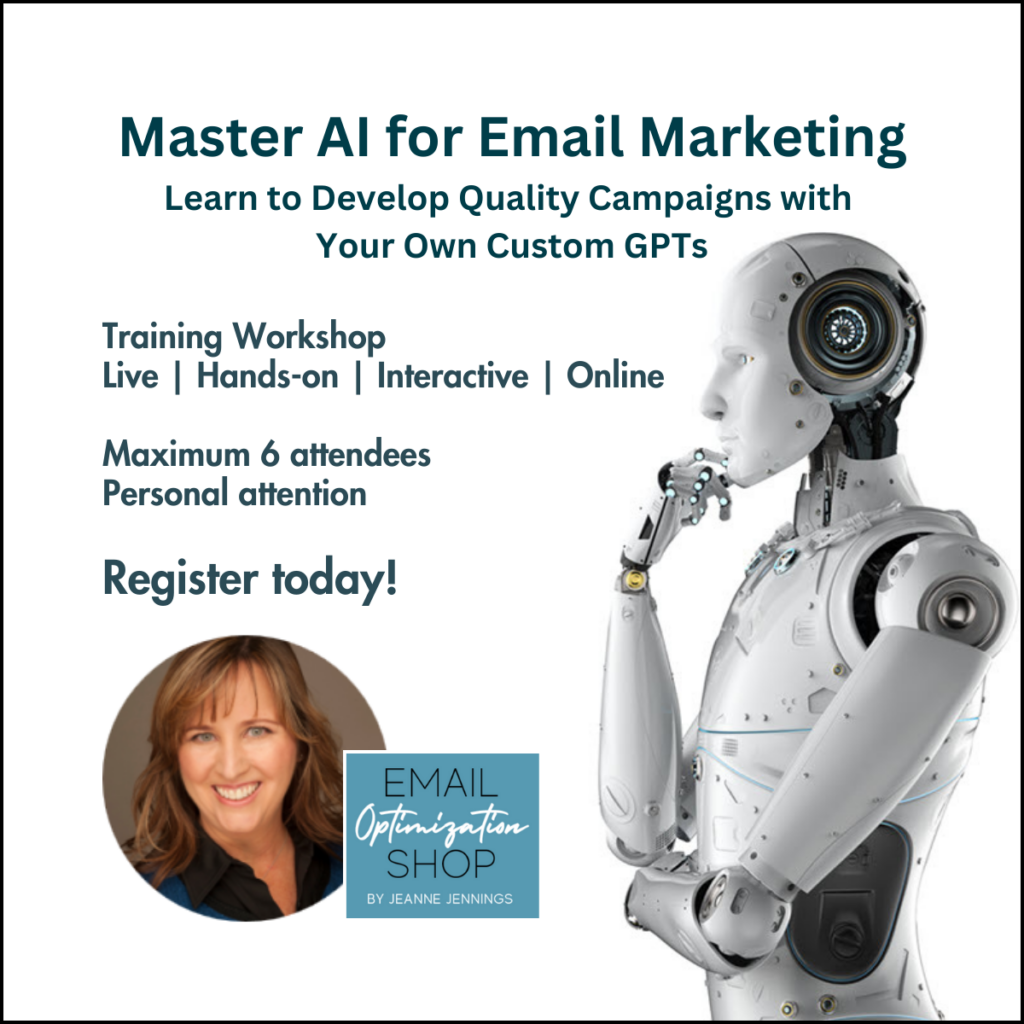
Join me for my Master AI for Email Marketing Workshop, a live, hands-on 6-hour training over 2 days where we’ll turn AI from buzzword to business tool.
You’ll leave with real skills, real prompts, real confidence — and 3 of your own custom GPTs.
Get all the details and save your seat here.
Until next time,
Want your own custom AI that actually gets your brand?
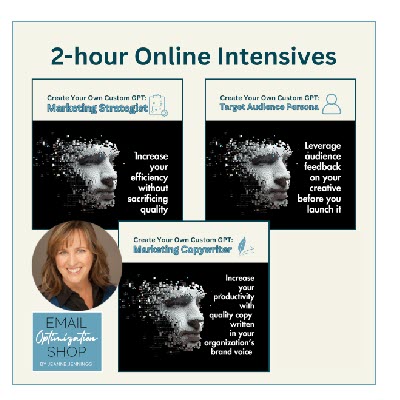
Join one of my 2-hour GPT Marketing Intensives and build your own custom AI assistant, whether you need a Strategist, a Persona Expert, or a Copywriter.
It’s fast, focused, and designed for marketers who want more than generic prompts.
Pick your intensive and reserve your spot here.
jj
This is the first in a series of articles on Human-first Marketing in the Age of AI. Read the second article, How to Personalize/Customize Marketing Without AI and Still Build Trust and sign-up for the Email Optimization Shop newsletter so you don’t miss the others in the series.
Jeanne Jennings is the Founder and Chief Strategist at Email Optimization Shop, a boutique consultancy and training organization where she helps clients craft more effective and more profitable email programs.
Learn more at www.EmailOpShop.com and sign up for our free newsletter to get more content like this.