
I’ve been seeing something lately that’s making my inbox twitch. It’s not a new offense, but it’s spreading, and I think it’s time we talked about it. I’m referring to email senders using some form of “do-not-reply” in their friendly from address.
Not the actual from address. Not the ‘do-not-reply@ourbrand.com’ address. The friendly from address, which usually says something like ‘Asana’ or ‘Gap’ or ‘Social Media Today’ or ‘Jeanne Jennings, Email Optimization Shop.’
Side note: Let me pause and acknowledge that, yes, many companies are still using “do-not-reply” in their actual from addresses, which is its own blog post (and spoiler alert: not a best practice). In fact, I’ve written about this right here and here (and yes, this last one was written almost 20 years ago in 2005. It’s been not-a-best-practice for 20 years. Sigh.)
But I digress. In this blog post we’re talking about the friendly from address which shows up in the inbox view. Stating “do-not-reply” in the friendly from is a whole new flavor of… well, let’s just say unfriendly UX.
Do Not Reply: Wait, Who Is This From?
Let me show you what I mean, here are a few screenshots from my inboxes:
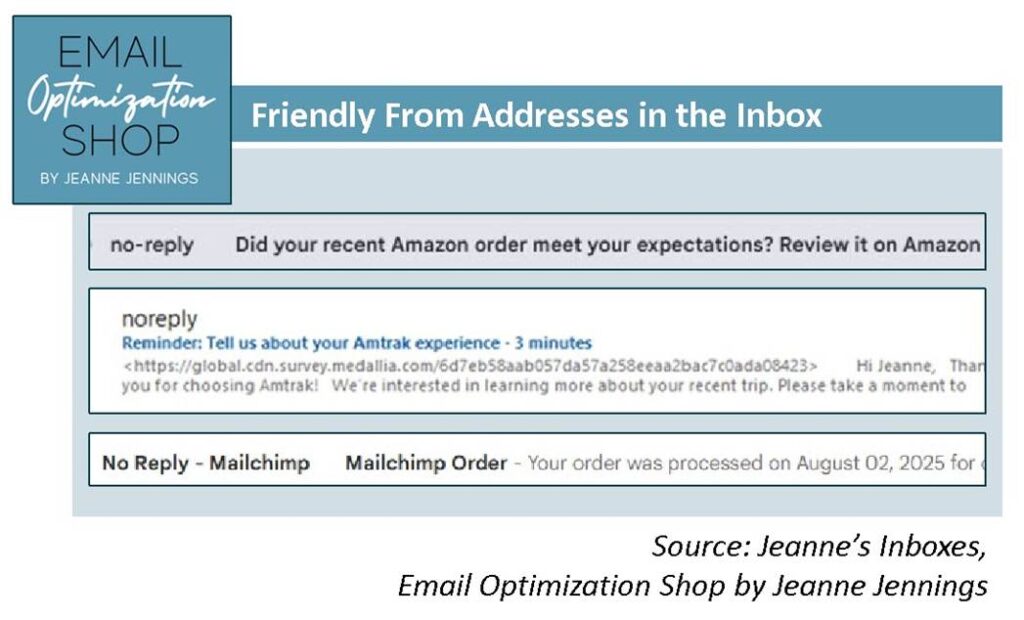
First let’s discuss another best practice that both Amazon and Amtrak are missing – including your brand in the friendly from address. Your friendly from address should be quickly recognized by your recipients. Even though both include their brands in the subject line, they would likely get better response if it were also in the friendly from address, the way MailChimp does it.
But I digress…
There’s some irony here. Take a look at the subject lines on the Amazon and Amtrak emails. Both are requests for feedback. They want my thoughts, but only on their terms. “Tell us what you think! But don’t reply to this email. That’s too people-y.”
It’s giving “We care, but only in survey form.”
And note: both of these emails are in response to a purchase – they are sending these to paying customers. Why would you not be willing to communicate with paying customers in their method of choice?
And the MailChimp email? This is the address they use for their billing-related messages. I get an estimate before my credit card is charged and a ‘your order was processed’ email after the fact. Unlike other emails I receive from MailChimp, these emails carry the ‘No Reply – MailChimp’ friendly from address. Which makes no sense to me.
Once again, if a paying customer has a question about their bill why would you not be willing to communicate with them, in their method of choice, to resolve it?
What’s the Real Problem Here?
When you use a form of “do-not-reply” in your friendly from address, you’re sending mixed signals at best –and actively damaging the subscriber relationship at worst.
Here’s what your subscribers (aka people) might be thinking:
- “So… you can talk to me, but I can’t talk back?”
- “This feels robotic and transactional.”
- “Wait, is this even a real message, or phishing?”
- “If I reply, will anyone see it? Will it bounce? Will it go into the void?”
And when the friendly from address includes “no-reply,” it’s the very first thing they see.
That space, your friendly from address, is prime inbox real estate.
It’s your billboard. Your handshake. Your first impression.
Why waste it on a warning?
Do Not Reply: What to Do Instead (Hint: It’s Not That Hard)
Even if you don’t accept replies (which you should), there are simple, smart alternatives to the dreaded “do-not-reply” friendly from address. These preserve functionality and make your brand feel more approachable. Here’s where to start:
1. Use a human- or brand-friendly name that reflects the nature of the message.
Your friendly from address does more than just label the email. It sets the tone for the interaction. It’s often the first thing people see (especially on mobile). It signals whether this is a message from a brand they trust — or a transactional afterthought they can ignore. So be intentional. Be clear. And when in doubt, err on the side of human.
Examples for the messages above:
- “Amazon Customer Experience”
- “Amtrak Feedback Team”
- “Mailchimp Billing
2. Set up a monitored reply-to address
Don’t underestimate what a reply can reveal. Subscribers will sometimes hit “reply” to let you know a link is broken, a discount code didn’t work, or to share something thoughtful that your content sparked. Inboxes may be crowded, but engagement like this is gold, and it can flag potential issues early, before they spiral.
If your ESP or CRM makes routing replies tricky, consider setting up a shared inbox or even forwarding replies to support or marketing. You don’t need to reply to every single message manually, but it’s smart to listen for patterns, and it’s good subscriber hygiene to make sure people don’t feel like they’re shouting into the void.
3. Autoresponders are your friend.
Worried about out-of-office replies or autoresponders from your subscribers? Most modern ESPs filter those out automatically. Really. It’s not 2004 anymore.
You can also set up your own auto-response that:
- confirms receipt of the message,
- sets expectations (e.g. “We read everything but may not reply to each one”), and
- provides alternative support options if needed.
It’s a low-effort, high-trust move. One that says: Yes, we emailed you. And yes, we’re open to hearing back.
Final Thought: Your Email Program Isn’t a One-Way Street
I get it. Managing inbound replies can be messy. But if you’re going to show up in someone’s inbox, especially with something like a billing notice or a feedback request, then you’re in a relationship. And relationships go both ways.
Using a form of “do-not-reply” in the friendly from address is like saying, “We’re talking at you, not with you.”
Not exactly a brand moment to be proud of.
So let’s retire this practice. Or at least keep it where it belongs, in the background — if it must exist at all.
Better yet: start treating the inbox like the two-way street it’s meant to be.
Your subscribers, and your bottom line, will thank you for it.
Until next time,
jj
Jeanne Jennings is the Founder and Chief Strategist at Email Optimization Shop, a boutique consultancy and training organization where she helps clients craft more effective and more profitable email programs.
Learn more at www.EmailOpShop.com and sign up for our free newsletter to get more content like this.

Photo by LOGAN WEAVER | @LGNWVR on Unsplash